Quick answer
Tongue bleeding after scraping usually means the tool has irritated or cut the surface. Pressing hard, repeating passes, or dragging over a sore spot can all cause it. Stop scraping, rinse gently, and hold clean gauze or cloth against the area if it still bleeds. Don't restart until your tongue feels comfortable and no longer bleeds.
A small surface injury often settles without treatment. Bleeding isn't proof that your tongue is cleaner. Get urgent help for heavy bleeding that won't stop, or swelling that affects your breathing.
Why a tongue scraper can draw blood
Your tongue is soft tissue with a textured surface. Tiny bumps called papillae can trap bacteria, dead cells, and food debris. A scraper is meant to lift that loose coating. It shouldn't remove tissue.
Most bleeding follows a simple mechanical problem:
- You are pressing hard enough to scrape the surface.
- You keep going over the same area after the loose coating has gone.
- You drag the tool across an ulcer, bite, burn, or other sore spot.
- You reach so far back that you lose control of the pressure.
- Blood from a nearby gum or mouth sore gets mistaken for tongue bleeding.
The timing gives you a useful clue. A thin red streak that appears during scraping points to local irritation. Bleeding that starts without scraping, returns often, or has no visible source needs a dental check.
Don't chase a perfectly pink tongue. Colour and texture vary, and some coatings do not come off with cleaning. More pressure adds injury, not cleanliness.
What to do right now
Put the scraper down. Do not make another pass to see whether the bleeding has stopped.
If you can see the bleeding point, press clean gauze or a clean cloth firmly against it. Healthdirect advises constant pressure for 10 minutes for a mouth or tongue cut. Stay upright, and gently spit out collected blood rather than swallowing it.
Once bleeding has stopped, rinse gently with clean water. A warm saltwater rinse can ease a minor mouth injury. Healthdirect uses one teaspoon of salt in one cup of water. Swish gently and spit it out.
Give the area time to settle. While it is sore, avoid spicy, acidic, or hot food and drink. The NHS also advises avoiding alcohol and smoking when a tongue is irritated.
Do not scrape the area again while it is tender, raw, or bleeding. Repeatedly reopening the same spot delays the point at which you can judge whether it is healing.
How to restart without causing another cut
Tongue cleaning is optional. If it repeatedly hurts you, skip it and ask a dentist whether it adds anything useful to your routine.
If you choose to restart, wait until the tongue feels normal. Then change the technique:
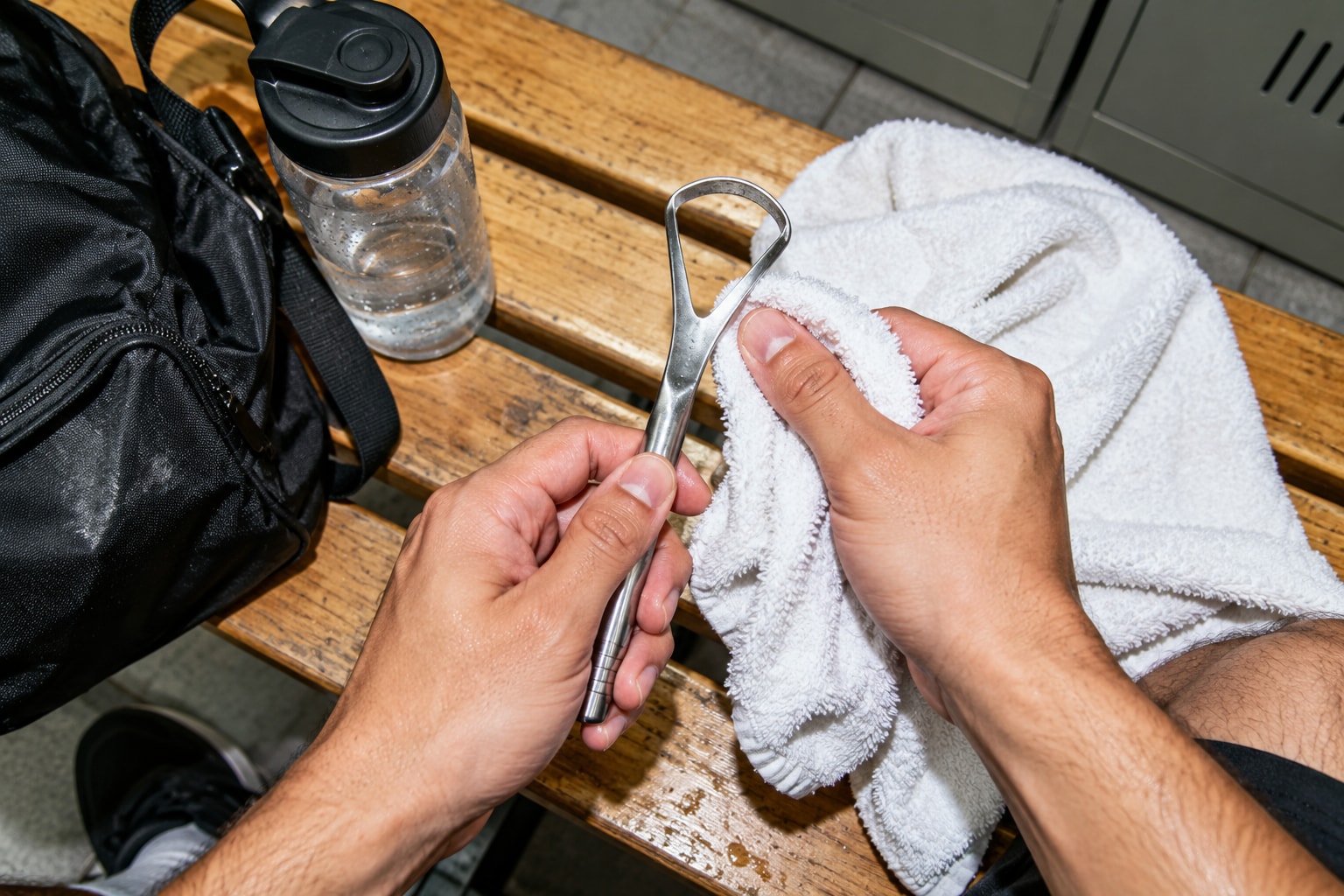
- Use a smooth tongue cleaner or a soft toothbrush.
- Wet the tool so it glides instead of dragging.
- Place it only as far back as feels comfortable.
- Pull slowly from back to front with light pressure.
- Make one or two passes over each area, then stop.
- Rinse and clean the tool after use.
You should feel contact, not pain. Stop at the first sting or trace of blood. If light contact still causes bleeding, leave the area alone and book a dental check.
A white coating may return during the day. That does not mean you should scrape harder or more often. Oral Health Advisory recommends gentle cleaning and says tongue cleaning does not replace brushing twice daily or cleaning between your teeth.
When the coating needs checking instead
A scraper cannot diagnose or treat every white or coloured area. The NHS lists oral thrush, mouth ulcers, geographic tongue, lichen planus, and leukoplakia among possible causes of a sore or white tongue. Their treatments are not the same.
Arrange a dentist or GP appointment if:
- a white or coloured patch does not rub off;
- tongue pain or itching persists or gets worse;
- an ulcer, lump, or patch has not healed after two weeks;
- bleeding returns despite gentle technique;
- the source of the blood is unclear.
Do not try to scrape a fixed patch away. That can create a wound on top of the original problem and make the area harder to assess.
When bleeding needs urgent care
Most small tongue cuts stop with pressure. Healthdirect advises urgent medical help if mouth bleeding continues after 10 minutes of constant pressure.
Seek urgent dental or medical care sooner if the bleeding is heavy. Do the same for increasing pain, marked swelling, discharge, fever, or feeling unwell.
Call emergency services for heavy mouth bleeding that will not stop. Severe swelling that affects breathing is also an emergency. These are not routine tongue-scraper side effects.

Is tongue scraping worth continuing?
The possible benefit is modest. A 2010 systematic review found five eligible studies covering seven experiments. Mechanical tongue cleaning reduced tongue coating and some measures of breath odour. The authors still found too little evidence about chronic bad breath to draw a firm conclusion.
UCLA Health also describes tongue cleaning as optional. It may reduce debris and bad breath, but it is not listed by the American Dental Association as a required oral-hygiene step.
That tradeoff matters. A habit with a possible short-term benefit is not worth repeated cuts. Gentle use is the limit. If bad breath or a coating keeps returning, a dentist can look for a cause that scraping cannot fix.
FAQ
Is a little blood normal after tongue scraping?
No. A healthy tongue should not need to bleed for the scraper to work. A one-off streak often follows excess pressure, but repeated or unexplained bleeding should be checked by a dentist.
How long should I stop scraping after bleeding?
There is no fixed evidence-based waiting period. Wait until the cut, soreness, and bleeding have fully settled. If the area is not improving, or it reopens with light contact, do not restart before a dental review.
Can I use a toothbrush instead of a tongue scraper?
Yes. The NHS says you can brush your tongue or use a scraper for a white tongue. Use a soft brush, light pressure, and stop if either method causes pain or blood.
Why is my tongue still white after scraping?
Loose coating can return, and some white areas are not removable debris. A patch that does not rub off, keeps returning with soreness, or lasts for two weeks needs a dentist or GP assessment.