Quick answer
Gagging when scraping your tongue usually means the scraper has reached an area that triggers your protective gag reflex. Start farther forward, use light pressure, and stop if you begin to retch. Don't force yourself to reach the back or remove every trace of coating. The American Dental Association considers tongue cleaning optional, so you can skip it if it keeps making you sick.
Why a tongue scraper sets it off
Touching the back of your tongue or throat can trigger an automatic tightening of your throat muscles. Cleveland Clinic explains that this reflex helps protect your airway, and sensitivity varies between people.
Contact with a sensitive area of your tongue can be enough, even without touching your throat.
Cleveland Clinic dentist Anne Clemons identifies forceful brushing as another trigger, especially around the back of your mouth. Her advice concerns toothbrushing, so slowing down during scraping is a practical suggestion rather than a treatment proven in trials.
Change where you start and how you move
Keep the scraper within comfortable reach, without testing how far back you can tolerate it.
For an optional, gentle attempt:
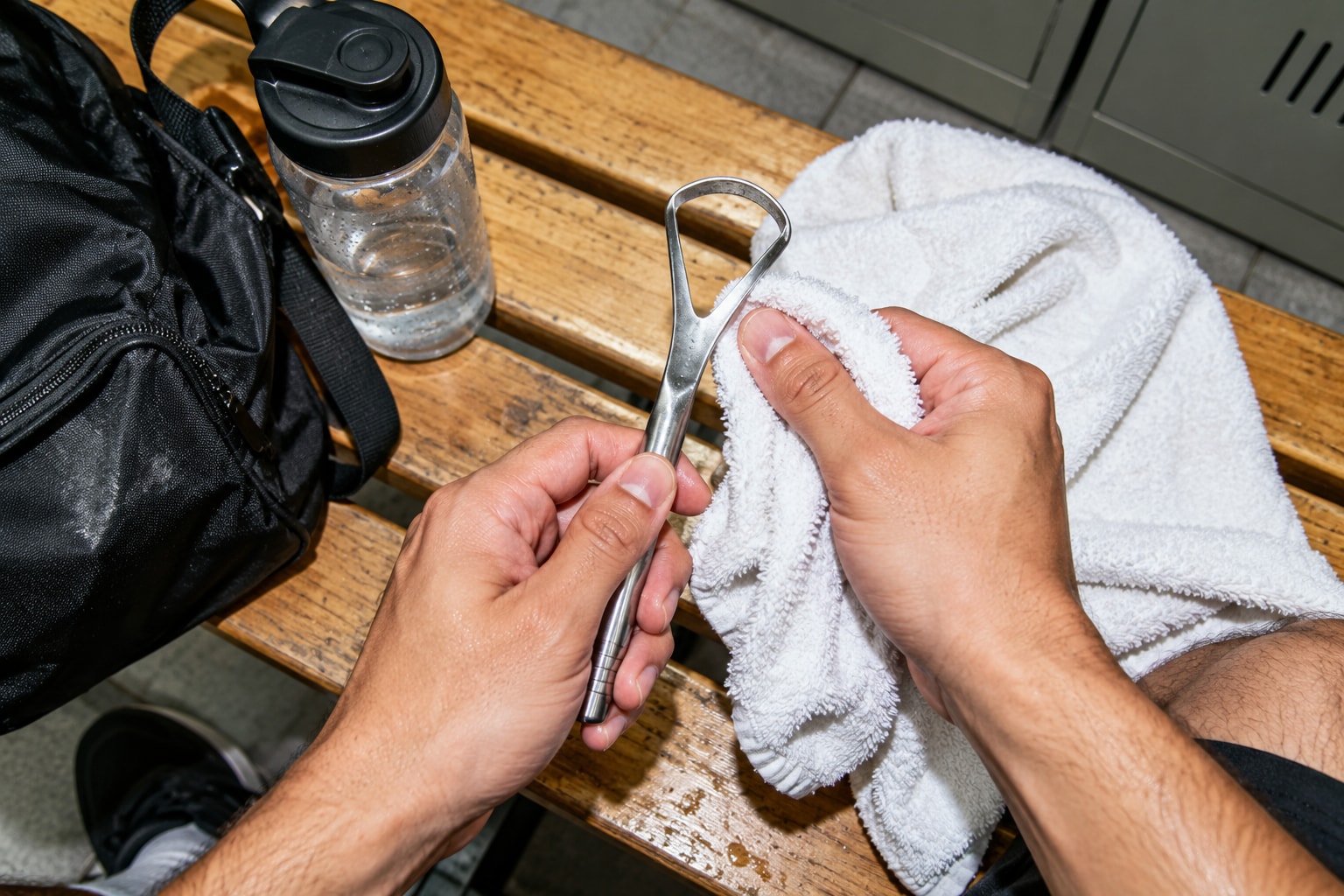
- Stick your tongue out comfortably. Place the scraper farther forward than the spot that usually sets off gagging.
- Draw it towards the tip with light pressure, keeping each stroke directed away from your throat.
- Start with one gentle pass, then rinse the tool and decide whether you want to stop.
- Stop straight away if you gag, feel pain or see bleeding. Don't finish a set number of strokes just because a video recommends it.
Cleveland Clinic's tongue-cleaning guidance recommends light pressure, one or two passes, and rinsing the scraper after each pass. Starting farther forward adapts that technique to avoid the area that triggers your reflex.
Let comfort set the limit.
If you want to try again another day, change one thing first, such as your starting point.
Choose a tool for comfort
A bulky tool may be awkward to position without touching sensitive areas. Clemons recommends a smaller toothbrush head for brushing-related gagging, but this doesn't prove that a particular scraper prevents it.
The ADA recognises both toothbrushes and dedicated scrapers as options, so choose something you can control comfortably.
If a soft toothbrush feels comfortable on your tongue, you can use it gently instead. If both methods make you retch, skip tongue cleaning and ask your dentist if routine care also becomes difficult.

Don't force a perfectly pink tongue
Stop trying to scrape away a patch that won't lift with gentle cleaning. The NHS notes that a white tongue has several possible causes, and some white patches need professional assessment.
Book a dentist or GP appointment for white patches, or tongue pain or itching that persists or worsens. Don't diagnose thrush from a photograph or treat every white area as removable debris.
Pain and bleeding aren't signs of a better clean.
You don't need to produce a large amount of residue to prove that cleaning worked.
Treat gag-reflex tricks as uncertain
Breathing calmly through your nose, when comfortable, is a low-risk suggestion in Clemons's advice for brushing-related gagging. It may help you relax, but it won't guarantee that you can reach farther back.
A 2019 Cochrane review included four trials involving 328 people who struggled with gagging during dental treatment. It gave evidence for the tested methods, including acupuncture and acupressure, its lowest certainty rating.
Those findings concern dental procedures and don't establish a reliable method for suppressing gagging during home tongue scraping.
Don't use numbing sprays or medicines just to tolerate scraping; discuss treatments with your dentist. For an optional grooming step, stopping is the simpler choice.
When to ask your dentist
Ask your dentist for help if gagging prevents you from brushing your teeth comfortably. Seek medical advice if it also disrupts eating or keeps causing vomiting. Tell your dentist whether the problem is new and whether it also happens without the scraper.
Mention reflux or postnasal drip, which Cleveland Clinic lists among possible contributors to a sensitive gag reflex.
Keep twice-daily brushing with fluoride toothpaste and daily cleaning between teeth as your priorities, as the ADA recommends.

FAQ
Why can I brush my teeth but gag with a scraper?
A scraper may contact sensitive tongue tissue that your toothbrush avoids when cleaning your teeth. Gag-reflex sensitivity also varies, so tolerating brushing doesn't guarantee that scraping will feel comfortable.
Does squeezing my thumb stop gagging?
Cleveland Clinic describes evidence for acupressure as limited, so squeezing your thumb shouldn't be treated as a dependable fix. Don't use a distraction trick as permission to push farther back.
Is it OK to stop tongue scraping?
Yes, the ADA calls tongue cleaning a matter of preference rather than a required step. Continue your usual dental care, and ask your dentist about persistent symptoms rather than trying to scrape them away.