Quick answer
Why do glasses make my eyes look smaller? Nearsighted prescriptions use minus lenses, which create a real minifying effect that grows with stronger lens power.
A smaller, well-centred frame fitted closer to your eyes can often reduce it. Rounder lenses may help too, but no frame can fully cancel a strong prescription.
The lens changes what other people see
This isn't your eye changing size. It is optics.
Myopia, or nearsightedness, is corrected with a minus-powered concave lens, which spreads light before it reaches your eye. Viewed from the other side, it makes your eye and the nearby face look smaller through the lens.
Plus lenses for farsightedness do the reverse and can magnify the eyes. If only one eye has a much stronger prescription, the two eyes may also look different in size through glasses.
The StatPearls chapter on the lensmaker's equation identifies two main drivers here: lens power and vertex distance. More minus power increases minification, and moving a minus lens farther from the eye increases it too.
That second point gives you one useful option: a frame fitted safely closer to your eyes may reduce the effect. An optician should make that adjustment because lashes, lens angle and comfort still matter.
What can make the effect less obvious
The best result usually comes from treating the frame and lenses as one system. Bring your current prescription when you shop and ask to see frame measurements, rather than just styles.
Choose a smaller, well-centred frame
The American Optometric Association advises small eye sizes and round lens shapes when optimizing glasses for myopia. Here, "eye size" means the frame's lens width, not your actual eye.
Smaller, rounder openings remove more unused lens area, which usually reduces thick outer edges and keeps the finished glasses lighter. A 2020 Magazine guide for opticians also stresses centration: your pupils should sit close to the intended optical centres.
Don't chase the smallest frame on the shelf because it still needs to fit your head, bridge and pupil distance. Ask the optician for the smallest suitable shape that centres your eyes without pinching.
Ask about vertex distance
Vertex distance is the gap between the back of the lens and the front of your eye. For minus lenses, a larger gap produces more minification.
Ask whether the chosen frame can sit a little closer while keeping safe lash clearance. Nose-pad and bridge adjustments may help, but don't heat, bend or force the frame yourself.
Understand what high-index lenses actually do
High-index material bends light more efficiently, so a strong prescription can be made with less bulk. The American Academy of Ophthalmology describes these lenses as thin and lightweight, which can make thick edges less conspicuous.
It doesn't erase the prescription's minification.
Spectacle magnification also depends on lens power, distance, curve, thickness and refractive index. High-index material mainly gives you a thinner profile. The change in apparent eye size depends on the whole lens design, so don't accept a guaranteed "natural-size eyes" claim.
Ask whether an aspheric design suits your prescription
An aspheric lens uses changing curves instead of one simple spherical curve. It can produce a flatter, slimmer lens and may reduce some visible distortion, though the benefit varies by prescription, frame and manufacturer.
Ask the optician to compare an aspheric option with a standard lens using your actual measurements. It may help, but it cannot make a strong minus lens behave like plain glass.
Use anti-reflective coating for visibility
Anti-reflective coating doesn't change image size, but it cuts distracting reflections so people can see your eyes more clearly. It also helps your glasses look cleaner in photos and video calls.
This is a finishing improvement, not an optical cure.
A practical ordering checklist
Take this list to an optician before paying:
- Confirm that the prescription is current.
- Look for a smaller round or oval frame that still fits well.
- Check that each pupil sits near the correct lens centre.
- Ask how close the frame can sit without your lashes touching.
- Compare estimated edge thickness across suitable lens materials.
- Ask whether an aspheric design changes the result for your prescription.
- Add anti-reflective coating if glare hides your eyes.
If possible, ask for the finished lens thickness estimate. A demo frame contains lenses with no prescription, so its shop-floor appearance can be misleading.
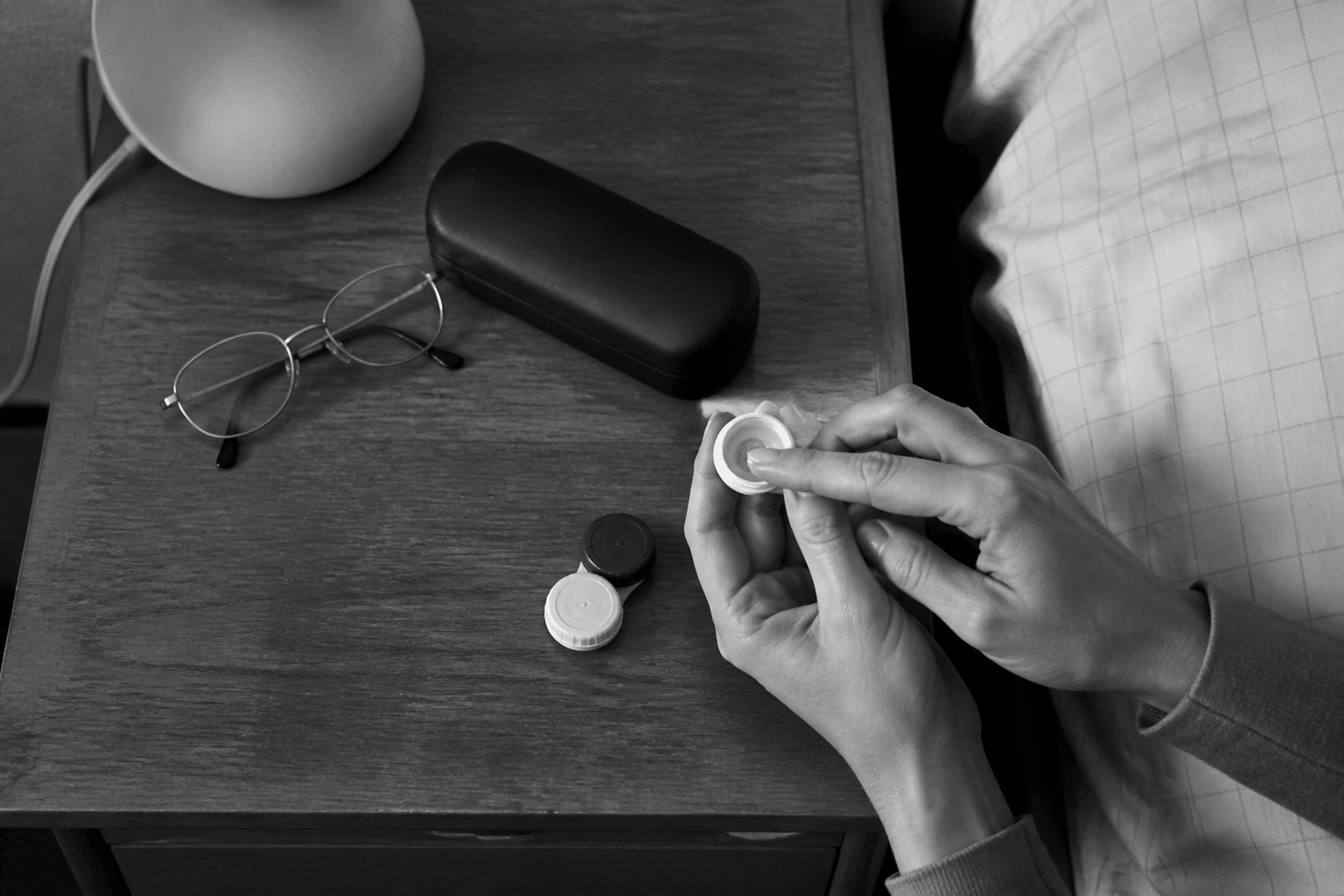
Contacts remove the spectacle effect, but need proper care
Contact lenses sit on the eye rather than several millimetres in front of it. That near-zero vertex distance removes most spectacle minification, making your eyes look closer to their uncorrected size.
They aren't a casual cosmetic accessory: the US Food and Drug Administration warns about infections, corneal ulcers and, rarely, vision loss. You need a valid fitting and must follow the wear, cleaning and replacement instructions.
If you already get dry or irritated eyes, tell the clinician before trying them. Glasses may remain the better daily option even if contacts change the appearance more.
Don't weaken your prescription for appearance
Undercorrected glasses trade clear vision for a small cosmetic change and can make driving, work and daily tasks less safe. They also don't solve the underlying optics in a controlled way.
Keep the prescription your eye-care professional provides, and change the frame fit, lens geometry or correction method instead.
Skip online "eye enlargement" exercises too because they cannot cancel the image formed by a minus lens. The fix has to involve the optical setup.
Compare frames without letting the camera decide
Phone photos can add glare and make a frame look different from one shot to the next. Use the same camera, distance, head position, lighting and expression for each comparison.
Take one straight-on photo and one slight turn, then compare eye visibility, frame fit and edge thickness. Don't judge from a close selfie in one frame and a distant portrait in another.
FAQ
Do all glasses make eyes look smaller?
No. Minus lenses for myopia minify, while plus lenses for farsightedness can magnify. A mild prescription may create little visible change, while stronger powers usually make the difference easier to notice.
Do high-index lenses make your eyes look bigger?
Not automatically. They make strong lenses thinner and often lighter, which can improve the finished appearance. They don't remove the power-based minification, and the result also depends on curve, thickness, fit and vertex distance.
Are small frames always better for high myopia?
Smaller, rounder frames often reduce edge thickness and make good centration easier. The frame must still match your pupil distance and fit your bridge. Let an optician balance those measurements rather than choosing by size alone.
Can contact lenses stop eyes looking smaller?
They can remove most spectacle-related minification because they sit directly on the eye. Contacts still require a professional fitting and careful hygiene, and they aren't suitable or comfortable for everyone.