Quick answer
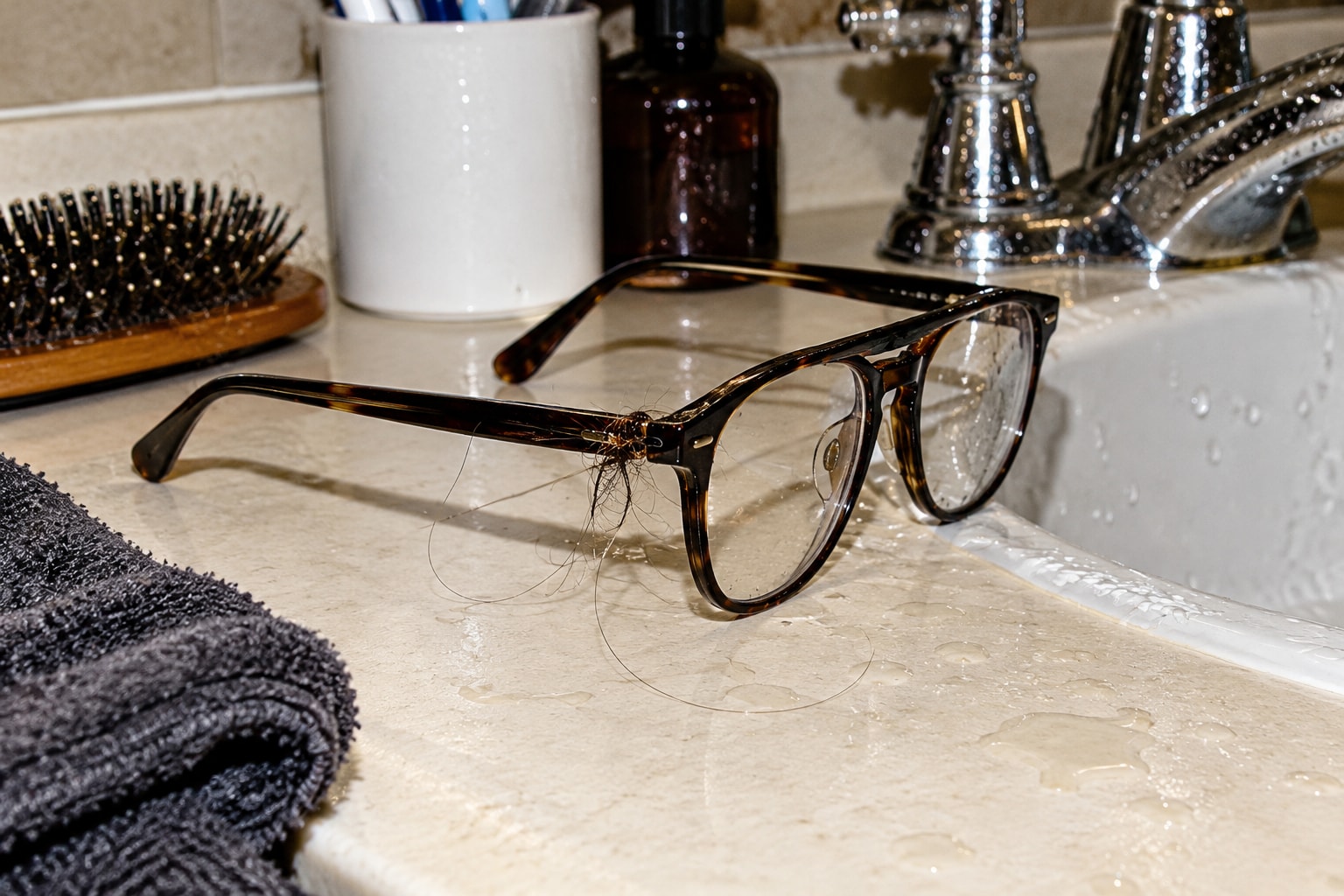
If you notice hair getting caught in glasses hinges, find the exact snag point before choosing a fix. The catch may be at the hinge, or at a rough edge farther along the arm. Free the strand gently, keep hair clear when removing your glasses, and have an optician inspect any spot that repeatedly catches.
Find the part that's catching
Don't assume the hinge is responsible because the pulling happens near your ear. The hinge joins the arm to the front of your glasses, while the arm tip rests behind your ear.
In his optician training article, Getting Adjusted—Part 2, Andrew Bruce describes rough openings on arm-tip covers catching hair. These covers fit over the ends of some metal arms, so the problem can sit well behind the hinge.
At the next snag, stop moving your glasses and look for where the strand is trapped. Ask someone to help if you can't see it. Once the hair is free, check the frame under good light.
- At the front joint: show the optician the precise gap where the strand caught.
- Behind the ear: check where a plastic tip cover meets the metal arm.
- After pushing glasses onto your head: locate the trapped strand before blaming the hinge.
These checks help locate the problem, but they don't tell you whether a screw needs tightening or a part needs replacing.
Free trapped hair without yanking
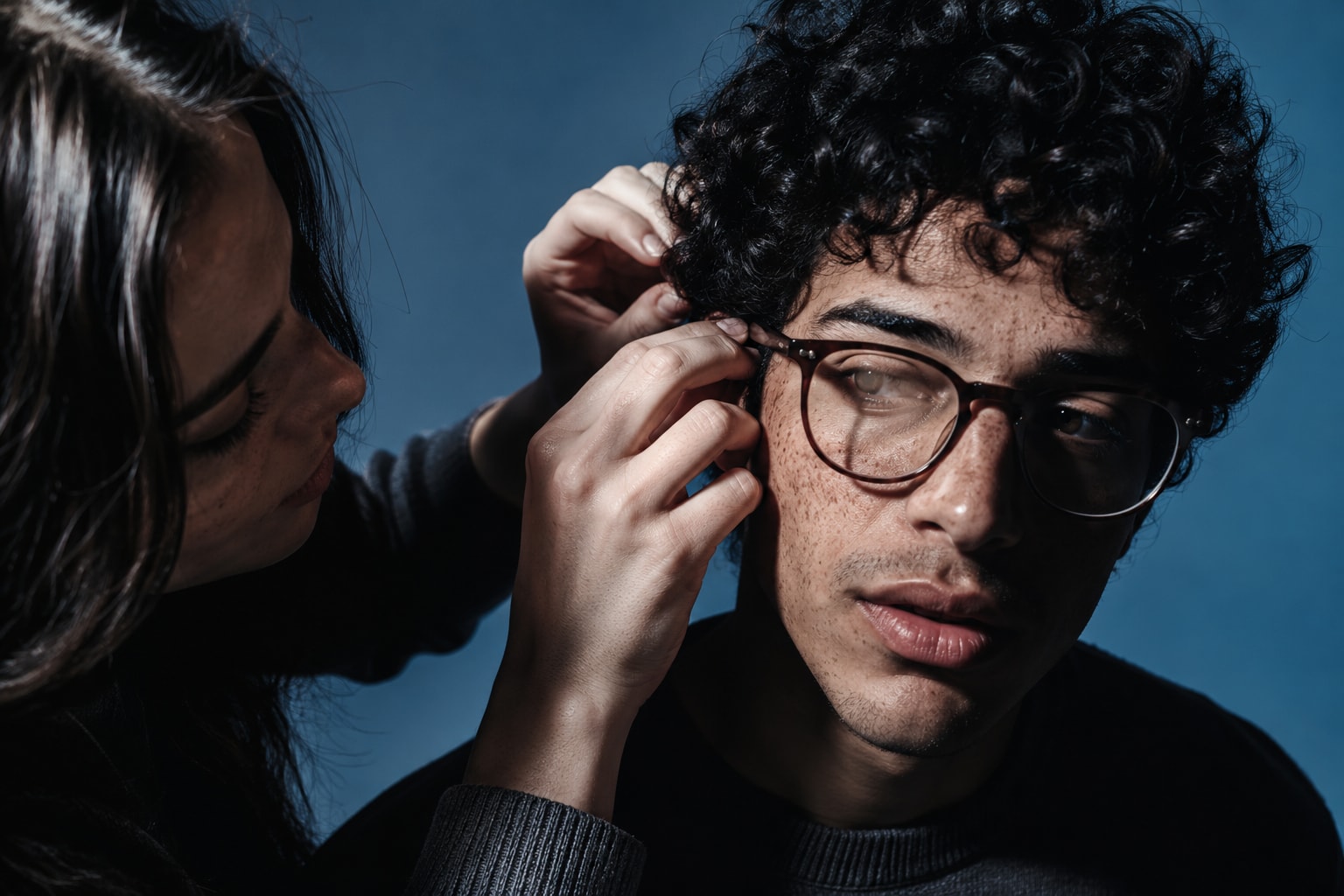
Stop as soon as you feel a pull and support the glasses so their weight isn't dragging on the caught strand. If you can see the hair clearly, gently ease it out with your fingers.
Don't pull the frame away while the strand stays trapped or open and close the arm to force it loose. If it won't release easily, ask for help instead of pulling harder.
The American Academy of Dermatology (AAD) warns that repeated pulling can damage hair, which is why removing the tension comes first.
Change the movement that triggers it
Move loose hair away from the sides, then hold both arms and remove the frame slowly. Wait until it's clear of your hair before folding it.
The Association of British Dispensing Opticians (ABDO) recommends two-handed removal. It explains that repeatedly removing glasses with one hand can stretch the hinge on that side.
Keep your glasses off the top of your head, too. Dispensing optician Evelyn Field, writing for Buchanan Optometrists, identifies wearing glasses as a hairband as a cause of splayed frames. Put them in their case when you take them off.
Use a loose clip to move your fringe aside without pulling your hair into a tight style.
What to ask your optician
Show the optician where the hair catches and explain when it happens. A useful script is: “Hair catches at this spot when I remove my glasses. Please check the joint and the arm-tip edge.”
Mention whether it started after a knock, an adjustment, or a change of frames. Ask them to watch you put the glasses on and take them off, without deliberately trapping hair.
Bayfields lists hinge tightening, screw replacement and arm realignment among the problems its teams assess. Bruce's training article also describes professional smoothing of rough tip-cover openings. The repair should match the part that's causing trouble.
Check comfort after the work, since ABDO explains that fitting includes keeping the frame level and aligning the lenses with your eyes.
If it slips, hurts behind your ears, or needs tilting for clear vision, tell the optician before leaving. Field identifies these as reasons for adjustment.
Skip glue, filing and heat
Don't fill the hinge with superglue or reshape the arm with household tools. Bayfields warns that glue and heat can damage frames or lens coatings and make later repairs harder.
Leave rough-edge polishing to the optician.
If you're considering a sleeve or hinge cover, ask your optician whether it suits the frame before fitting it.
When a different frame makes sense
Ask about replacement only after checking whether your current frame can be repaired or adjusted. Bayfields notes that repair options depend on the frame's material, design and condition.
Silhouette's Titan Minimal Art is one example of a screwless, hingeless design. Removing the hinge removes that particular catch point, but it doesn't prove the whole frame can't snag hair.
Try any replacement with your usual hairstyle. Put it on and remove it gently, then ask the optician to inspect the areas near your hair.
FAQ
Why does hair catch on only one side?
A hinge or arm-tip edge on that side may be responsible, so compare both arms before choosing a fix. Tell the optician which hand you use to remove your glasses: ABDO notes that repeated one-handed removal can stretch that side's hinge.
Can glasses pulling hair cause a bald patch?
Repeated tension can cause breakage and traction alopecia, but a few trapped hairs don't mean you have that condition. The AAD lists broken hairs, a receding hairline and patches of loss as warning signs. See a dermatologist if you notice persistent thinning or a bald patch. Don't assume the glasses explain every change.
Will hingeless glasses stop the snagging?
They remove the hinge as a potential catch point, but that alone doesn't mean they'll solve your problem. Bruce's example of hair catching on arm-tip covers shows why the rest of the frame also needs checking. Try the fit before buying.