Quick answer
Finasteride for hair loss has solid evidence for slowing male pattern hair loss in adult men, and some men also gain visible density. It is better understood as a long-term preservation treatment than a guaranteed way to rebuild a juvenile hairline.
Results usually take months, benefits fade after stopping, and side effects deserve a real discussion rather than hype or panic. Because finasteride is a prescription medicine with sexual and psychiatric safety warnings, first confirm the diagnosis and make the decision with a qualified prescriber.
What does finasteride actually do to hair?
Male pattern hair loss, also called androgenetic alopecia, usually develops gradually at the temples, crown or both. Genetically susceptible follicles become smaller, producing progressively shorter and finer hairs. Dihydrotestosterone, or DHT, is one important part of that process.
Finasteride inhibits type II 5-alpha-reductase, an enzyme that converts testosterone into DHT. Lowering DHT can interrupt further miniaturisation in susceptible scalp follicles. It does not create brand-new follicles, change your skull or mechanically move your hairline. This is medical treatment for a particular form of hair loss, not a general-purpose “hairmaxxing” supplement.
That distinction matters. Sudden shedding, patchy loss and hair loss linked to another scalp or health condition may need a different investigation and treatment. A convincing social-media before and after does not establish either the diagnosis or the cause of improvement.
Does finasteride work for male pattern hair loss?
Yes, on average. The FDA prescribing information summarises three randomised, placebo-controlled trials involving 1,879 men aged 18 to 41 with mild-to-moderate male pattern hair loss. In the two crown studies, the treated group had a 107-hair advantage over placebo in a defined one-inch-diameter scalp area after 12 months. Further hair loss occurred in 14% of the finasteride group versus 58% of the placebo group at one year; at two years, the figures were 17% and 72%.
A systematic review reached the same broad conclusion: moderate-quality evidence showed that oral finasteride increased hair counts and improved patient and investigator assessments compared with placebo. “Works” still does not mean everyone regrows a large amount. Holding onto existing hair, slowing visible thinning or making miniaturised hair look somewhat denser can all be successful outcomes.
The evidence also has boundaries. The pivotal trials mainly studied younger men with incomplete hair loss, and 88% of participants were White. Group averages cannot predict your exact finasteride before and after result.
Who is a sensible candidate?
The starting point is a credible diagnosis of androgenetic alopecia. A gradual M-shaped recession, progressive temple thinning or a widening crown can fit the pattern, particularly with a family history. A clinician can examine the distribution and degree of miniaturisation and decide whether tests are needed.
Get assessed before focusing on DHT if loss is sudden, unusually diffuse, patchy or associated with scalp symptoms. For example, telogen effluvium can cause rapid shedding after physical or emotional stress and often behaves differently from gradual male pattern loss. Treating the wrong condition wastes time and may delay appropriate care.
The FDA-labelled hair-loss use is for men, and the evidence discussed here should not be generalised to women or children. Finasteride can harm a developing male fetus; someone who is pregnant or could be pregnant should not handle crushed or broken tablets. A prescriber can explain the precautions relevant to your household and circumstances.
What is a realistic finasteride results timeline?
Hair cycles are slow, so a weekly mirror check is mostly noise. A practical finasteride results timeline looks like this:
- Before treatment: confirm the diagnosis and take baseline photographs of the front, both temples, mid-scalp and crown.
- First three months: no obvious cosmetic change does not prove failure. FDA information says three months or more may be needed before benefit is observed.
- Three to six months: early stabilisation or improvement may become noticeable. Compare photographs, not memory or one day’s shower drain.
- Six to 12 months: this is a fairer window for judging visible response with your prescriber. The major trials detected hair-count differences at six and 12 months.
- Longer term: continued treatment is generally needed to sustain the effect, with periodic reviews of benefit and tolerability.
Keep the camera distance, angle, lighting, hairstyle, hair length and whether the hair is wet or dry as consistent as possible. Harsh overhead light, a fresh haircut or a different part can manufacture an impressive improvement or decline.
“Finasteride shedding” is often treated online as proof that the medicine is working. Do not use extra shedding as a success test. If shedding is marked, sudden or persistent, ask the prescriber to reassess it rather than diagnosing the cause from forum posts.
Does finasteride regrow a receding hairline or temples?
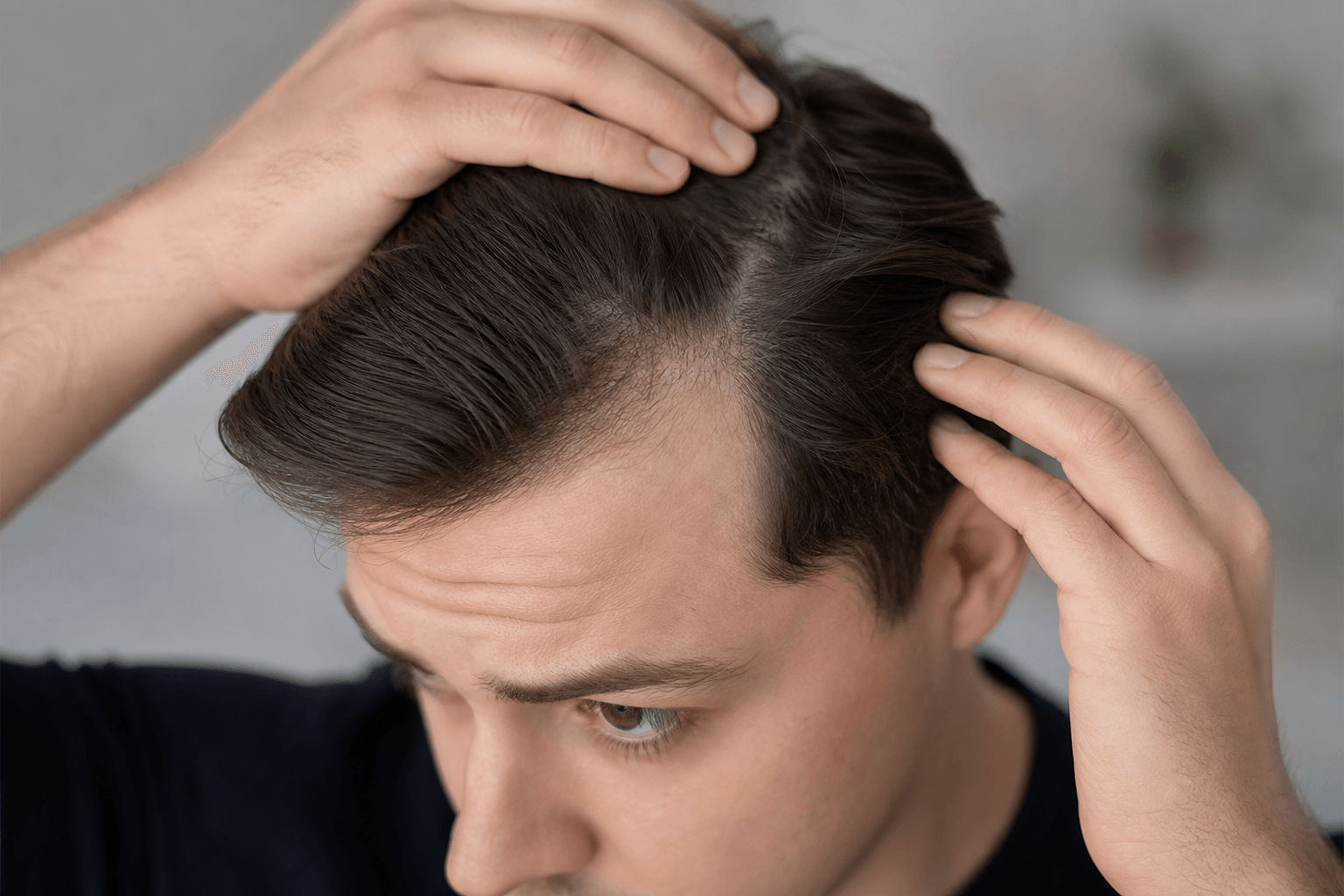
The honest answer is that the evidence is less certain at the corners. The FDA label says efficacy in bitemporal recession has not been established, and the anterior mid-scalp trial did not count the temporal hairline. Evidence is stronger for the crown and anterior mid-scalp than for rebuilding bare temples.
Finasteride for a receding hairline may still help preserve susceptible hairs, but “does finasteride regrow temples?” should not be answered with a guaranteed yes. Deep recession, long-standing smooth areas and a demand for a perfectly straight adolescent hairline make dramatic finasteride hair regrowth less realistic.
What are the real finasteride side effects?
Sexual side effects occurred in a minority of participants in the controlled trials, but they were more frequent with finasteride than placebo. During year one, decreased libido was reported by 1.8% versus 1.3%, erectile dysfunction by 1.3% versus 0.7%, and ejaculation disorder by 1.2% versus 0.7%. Across those categories, 3.8% of treated men reported one or more compared with 2.1% on placebo.
Those figures are useful context, not a promise that your personal risk is zero or exactly equal to a trial average. Post-marketing reports and regulator reviews capture issues that a trial may be too small or too short to characterise. The UK MHRA’s 2026 update says finasteride is associated with depression, suicidal thoughts and sexual dysfunction, which may persist after treatment stops. It advises prescribers to ask about a history of depression or suicidal thoughts and to monitor psychiatric and sexual effects.
If you develop low mood, depression, suicidal thoughts, reduced sex drive, erectile difficulty or ejaculation problems, contact your healthcare professional. UK guidance says a person taking finasteride for hair loss should stop it if depression or suicidal thoughts develop and contact their doctor as soon as possible. If you might seriously harm yourself, seek emergency help immediately. Follow the current patient leaflet and local regulator advice where you live.
This is why “is finasteride safe?” needs an individual risk-benefit answer. Discuss mental-health history, current sexual symptoms, other medicines, fertility plans and any relevant medical tests with the prescriber. Do not borrow tablets, change the regimen yourself or buy an unverified product because an influencer calls it risk-free.
Is topical finasteride safer than oral finasteride?
Topical finasteride is promising, but “topical” does not mean “stays only in the scalp.” In one 24-week phase III trial, a specific topical spray improved target-area hair count more than placebo and produced a numerically similar change to oral finasteride. Blood exposure was more than 100 times lower with the spray, yet serum DHT still fell by 34.5%, compared with 55.6% with oral treatment. That suggests lower systemic exposure, not zero systemic action.
Formulation and regulation matter. The FDA says there is no FDA-approved topical finasteride product in the United States and that compounded products have not been reviewed for safety, effectiveness or quality before marketing. It received 32 adverse-event reports involving compounded topical finasteride from 2019 through 2024 and warns about systemic effects, local irritation and accidental transfer to others. Reports cannot tell us the incidence because the total number of users and other reporting factors are unknown.
So an oral vs topical finasteride decision should be made with a qualified clinician using a clearly identified product. Do not assume a compounded spray has the same evidence as the exact formulation tested in a clinical trial, and do not apply mail-order medication without informed counselling.
How do you track progress without obsessing?
Use a small decision framework rather than letting every loose hair control the plan:
- Define success before starting: stabilisation can matter even without dramatic regrowth.
- Record a private baseline and take standardised photographs about once a month, not several times a day.
- Track any possible mood, sexual or scalp effects plainly and share them with the prescriber.
- Agree on a review point, commonly within the six-to-12-month evidence window, while reporting concerning effects immediately.
- If finasteride and minoxidil are both being considered, ask how to introduce and assess them without making it impossible to tell which treatment caused a benefit or problem.
Store progress photographs privately and read the privacy policy before uploading them anywhere. A face or skin score cannot diagnose androgenetic alopecia, and a single photograph cannot prove that a medicine worked. Consistent images can document a trend; diagnosis and prescribing still belong with a qualified professional.
Evidence-based looksmaxxing should leave room for a valid choice not to medicate. Hair can influence how you frame your face, but it does not measure health, attractiveness or personal worth. The useful question is whether the likely preservation benefit is worth the inconvenience, cost and possible adverse effects for you.
FAQ

Does finasteride regrow hair or only stop hair loss?
Finasteride can do both, but slowing or stopping further male pattern hair loss is the more dependable expectation. Controlled trials found better hair counts and visible assessments than placebo, while the amount of regrowth varied between men.
How long does finasteride take to work?
Finasteride may show an early benefit after about three to six months, but six to 12 months is a more useful window for judging cosmetic change. Compare standardised photographs and review progress with the prescriber rather than stopping after a few weeks.
Does finasteride work on a receding hairline and temples?
It may help preserve miniaturising hair around the front, but efficacy for bitemporal recession has not been established in the FDA label. Results at the crown and anterior mid-scalp are supported more clearly than complete temple regrowth.
What happens when you stop taking finasteride?
The protective effect is not permanent. FDA prescribing information states that withdrawing treatment leads to reversal of the effect within 12 months, so genetically driven hair loss generally resumes toward the path it would have followed without treatment.
Is topical finasteride safer than oral finasteride?
A trial of one topical spray found much lower blood exposure than oral finasteride, but topical treatment still lowered serum DHT and is not risk-free. Compounded formulas vary, and the FDA has not approved a topical finasteride product in the United States, so discuss the exact product and risks with a qualified clinician.