Quick answer
Current evidence does not show that creatine causes hair loss, and the best direct test so far studied 5 grams of creatine monohydrate daily. It found no creatine-specific change in DHT, hair density, follicle count, or hair thickness over 12 weeks.
That 2025 trial is reassuring, but 38 men completed it. It cannot rule out every long-term effect, every dosing pattern, or an uncommon response in someone already losing hair.
Why do people think creatine causes hair loss?
The claim has a scientific-sounding chain behind it: the theory says creatine raises dihydrotestosterone, usually called DHT. DHT can shrink genetically sensitive scalp follicles, which then produce finer and shorter hairs.
The problem is the first step. One small loading study reported higher blood DHT, but it did not measure shedding, density, recession, or baldness.
A possible mechanism is not a measured result, yet creatine and hair loss became linked online before researchers had tested the hair itself.
What does DHT have to do with male pattern baldness?
DHT plays a real role in androgenetic alopecia, the medical name for pattern hair loss. The British Association of Dermatologists describes this condition as a mix of hormonal and genetic factors. Susceptible follicles slowly become smaller, so each new hair grows finer and shorter.
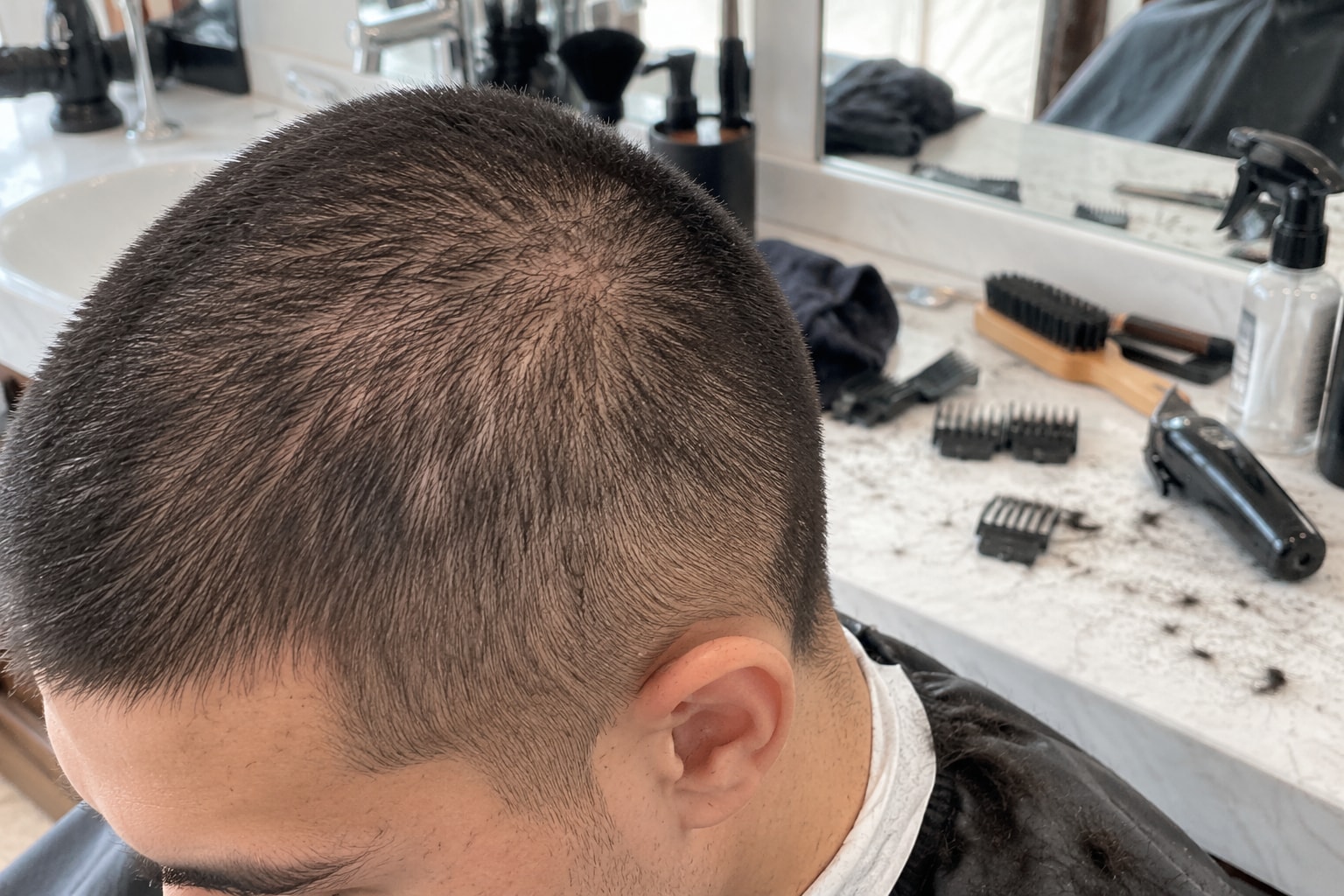
In men, the usual pattern includes frontal recession and top thinning, while hair at the sides and back is often spared. Susceptibility can come from either side of your family.
That context matters because a blood DHT result does not tell you how sensitive your scalp follicles are. It also does not prove that your hair count changed. This is why a hormone result can raise a useful question without answering it.
What did the 2009 creatine and DHT study find?
The original concern came from a three-week, double-blind, placebo-controlled crossover trial completed by 20 college-aged male rugby players.
During the creatine phase, they took 25 grams daily for seven days, then 5 grams daily for another 14 days. The placebo phase used glucose.
Blood DHT rose 56% from the creatine phase's baseline after loading and remained 40% above baseline after the maintenance period. Total testosterone did not change, and the researchers did not measure free testosterone.
Those percentages sound dramatic on their own, but the fuller data make them less decisive. A 2021 evidence review noted that baseline DHT was 23% lower in the creatine condition than in the placebo condition. DHT also stayed within the normal clinical range cited by the review.
Most of all, nobody checked the participants' hair through counts, standardized scalp photographs, density readings, or shedding measures. Three weeks is also too short to show the usual gradual course of pattern baldness.
The study found a hormone signal under a loading protocol, not evidence that creatine made anyone bald.
What did the 2025 creatine hair-loss trial measure?
The 2025 trial tested the missing link directly by recruiting 45 resistance-trained men aged 18 to 40. Researchers randomly assigned them to 5 grams of creatine monohydrate or 5 grams of maltodextrin placebo each day.
Thirty-eight men completed the 12 weeks while keeping their usual diets and training routines. The researchers checked total testosterone, free testosterone, DHT, and the DHT-to-testosterone ratio.
They also examined hair with a Trichogram test and a FotoFinder imaging system. The measures included hair density, follicular unit count, and cumulative hair thickness. These outcomes are far closer to the claim people care about than blood DHT alone.
The groups did not differ over time on any hormone or hair measure, including DHT, density, follicular units, or thickness.
This does not prove that a rare reaction is impossible. It does show that 5 grams daily produced no detectable hair-loss signal over three months in this group.
How much does the new trial settle?
The trial gives a better answer than anecdotes or the 2009 hormone result. It used a placebo, random assignment, direct hair measures, and a longer follow-up, but its boundaries are clear.
- Only 38 participants completed the trial.
- All were resistance-trained men aged 18 to 40.
- The study lasted 12 weeks, not several years.
- It tested 5 grams daily without a loading phase.
- Blood DHT cannot show the hormone activity inside each scalp follicle.
- Family history of hair loss was not recorded.
The paper reported no direct funding, though it thanked a BPI Sports representative for support and several authors disclosed supplement-industry ties.
The result applies most directly to healthy men using a standard daily dose. It does not directly answer the question for women, older adults, high-dose loading, or people with complex scalp conditions.
The wider hormone evidence does not strengthen the concern, based on a 2021 review of 12 other testosterone studies. Ten found no change in total testosterone, while two found small increases described as physiologically minor. Five studies measured free testosterone and found no increase.
Those were not hair-loss trials, but they failed to support a consistent hormonal path from creatine to baldness. The 2025 study then added the first direct hair measurements.
The fairest conclusion is narrow: current evidence does not show that creatine monohydrate causes hair loss.
What if your hair started shedding after creatine?
Do not dismiss the timing, but do not treat it as proof. Two events happening in sequence can share a cause, have separate causes, or be unrelated.
Write down when you started creatine, your dose, and whether you used a loading phase. Then check what else changed in the prior few months. Illness, fever, surgery, major stress, rapid weight loss, medication changes, and harsh hair care can all matter. Excess shedding after a body stressor may begin months later, so the newest change is not always the cause.
Next, look at the pattern. Slow temple recession or crown thinning fits male pattern hair loss more closely than one heavy shower shed. Sudden round patches, clumps of hair, scalp pain, burning, marked itching, scale, redness, or sores need medical assessment.
A dermatologist can review your pattern and determine whether you have hair loss, excessive shedding, or both. A blood DHT result alone cannot diagnose the cause.
Should you stop taking creatine if you notice thinning?
Current evidence has not established a hair-based reason for healthy men to stop 5 grams daily, but creatine remains optional. If the worry is affecting you, pausing it while you speak with a qualified clinician is reasonable.
A pause cannot prove causation because hair changes slowly, shedding fluctuates, and another trigger may resolve during the same period. Make one change at a time and keep a dated record.
Do not start finasteride, hormones, research chemicals, or an online “DHT blocker” to offset a theoretical creatine effect. Hair-loss medicines have real uses and real risks. A clinician should first confirm what type of hair loss you have.
If you continue creatine, the 2021 review found that 3 to 5 grams daily can build muscle creatine stores without loading. Loading works faster, but it is not required. Skipping it has not been proven to protect hair and simply keeps your routine closer to the dose tested in 2025.
How can you track hair changes without fooling yourself?
Hairline photos are easy to distort. Bright overhead light can expose more scalp. Wet hair forms gaps. A fresh haircut, longer fringe, styling powder, camera exposure, and head angle can all create false progress.
Use a simple monthly set instead:
- Take one front view, both temples, the top, and the crown.
- Use the same room, light source, camera, distance, and head angle.
- Keep your hair dry and free from styling products.
- Match hair length as closely as you can.
- Record your dose, loading phase, illness, weight change, stress, and new medicines.
- Compare sets after several months, not several times each day.
Keep the original files and dates. Store them on your own device or use a service with a clear privacy policy. Public face-rating forums add judgment, not diagnostic value.
Home photos can reveal a repeated visual trend, but they cannot identify the cause. The 2025 researchers used controlled imaging and hair tests, not casual selfies. If matched photos show steady recession, widening, or crown thinning, take them to a dermatologist.
When should you get professional help?
Book a dermatologist if thinning keeps progressing, your part widens, or a bald area grows, since different causes need different responses.
Seek care sooner for sudden patches, large clumps, pain, burning, heavy scaling, redness, open sores, or pus. These signs do not fit a simple supplement question and may point to a scalp or medical condition.
FAQ
Does creatine increase DHT?
One small 2009 loading study found higher blood DHT, but the result was not a hair-loss finding. A 2025 placebo-controlled trial using 5 grams daily found no creatine-specific change in DHT or hair measures. Current evidence does not show a reliable DHT increase from standard-dose creatine.
Can creatine speed up hair loss if baldness runs in your family?
No controlled trial has shown that creatine speeds pattern hair loss in people with a family history. The 2025 trial did not record family history. Genetics can raise your chance of androgenetic alopecia on its own, so matched photos and a dermatologist's exam are more useful than guessing.
Does creatine cause hair loss in women?
No trial has directly measured women's hair outcomes during creatine use. The strongest hair trial enrolled only men, so it cannot provide a firm women-specific answer. New thinning still deserves assessment because pattern loss, illness, hormones, nutrition, and medicines can have a role.
Will hair grow back after stopping creatine?
No controlled study shows that stopping creatine regrows hair, because creatine has not been shown to cause the loss. Regrowth depends on the real cause. If shedding continues or your hairline keeps changing, see a dermatologist instead of waiting for a supplement experiment to answer it.
Does a creatine loading phase cause hair loss?
There is no proof that creatine loading causes hair loss. The 2009 loading study found higher blood DHT but never measured hair. Loading is optional, and a daily 3-to-5-gram approach raises muscle stores more gradually without it.