Quick answer
You may search “why do I look worse in overhead lighting” after a harsh bathroom mirror check. The main reason is shadow direction, because light placed high above you deepens shadows around the eyes, nose, folds, and raised texture. Human studies confirm that lighting angle changes facial ratings even when the face stays the same.
That view isn't your “true” face; it is one version produced by one light position. Use a second, softer light and consistent photos before judging a skin or facial change.
What overhead lighting changes
Light from above hits the forehead, brow ridge, nose, cheeks, and upper lip first. Those features block part of the beam, leaving darker areas below the brows, nose, lips, and chin.
Your visual system uses these light and dark patterns to read facial shape. Palmer and colleagues showed that shading from above creates familiar face patterns that people detect well. That skill helps you recognize faces, but it can make a harsh ceiling light feel unforgiving.
The size of the source matters too, because a small or exposed ceiling light creates sharper boundaries between bright and dark areas. A broad, diffused source spreads light across more angles and leaves softer shadow edges. Dermatology photography guidance uses even lighting to limit shadows and glare for this reason.
Texture follows the same basic rule: light striking a raised bump from one direction creates a bright side and a shaded side. Work on surface perception shows that changing light direction can change how rough the same surface appears. That study did not test skin, acne, or pores, so it supports the visual mechanism rather than a skin diagnosis.
What the face studies found
Two small human studies tested this effect under controlled conditions, but their results do not define how every person will look.
Roelofs and colleagues photographed 10 people under six lighting setups. These included a light directly overhead, a ring light, natural light, and several front-biased arrangements. Viewers gave the overhead images lower attractiveness ratings than images lit from 45 degrees above and in front. The study produced 22,000 ratings, but it still photographed only 10 faces.
Hernandez and colleagues used 51 faces and 27 blinded raters, moving one light from face level to 30 and 60 degrees above it. At 60 degrees, attractiveness ratings fell and nasolabial folds looked more severe. Estimated age rose by less than half a year, and that change was not statistically significant.
So overhead light can change a rating, but it does not reveal hidden damage or give an objective attractiveness score. The evidence also does not show that it adds a fixed number of years.
Why one mirror can feel especially harsh
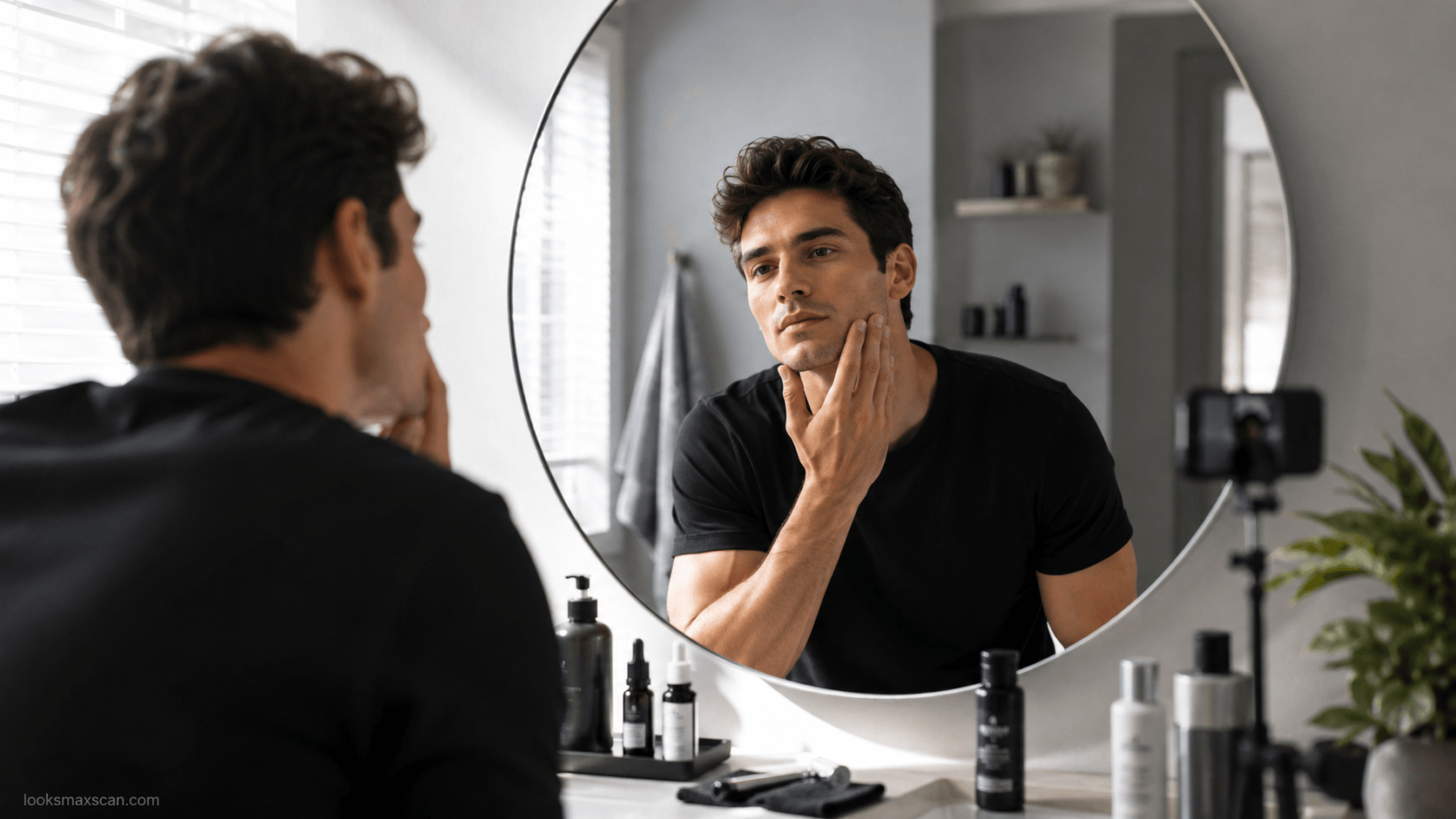
A real bathroom or fitting room controls almost nothing. You may stand closer, tilt your chin, squint, or compare yourself at a different time of day. Mixed daylight can also change between checks.
That makes memory a poor control, because you recall a general impression from another room rather than the exact angle and shadow pattern. A close inspection also directs your attention toward tiny details that most conversations never center.
The published lighting studies fixed the camera, background, expression, and other settings while changing one lighting variable. That is why their results can isolate light more cleanly than an everyday mirror check.
Use a two-light check
You can test the effect in five minutes. Change only the lighting, then compare the same view.
- Stand in one marked spot and keep the same posture and neutral expression.
- Take the first photo with the overhead light as your main source.
- Take the second with that light off. Face a large window or a broad lamp near face level.
- Keep the phone, lens, distance, zoom, exposure, and background unchanged.
- Turn off portrait filters, skin smoothing, and automatic retouching.
- Compare the under-eyes, nose shadows, folds, jawline, and visible texture. Do not compare your worth.
If the apparent problem changes with the light, you have found a viewing effect. It does not mean the feature is imaginary. It means its visibility is conditional.
For progress tracking, repeat one neutral setup rather than choosing whichever image looks best or worst. Dermatology photography guidance stresses matching settings between baseline and follow-up images, making a change easier to separate from a new shadow.
What helps in daily life
You do not need to avoid ceiling lights, since they help you see the room and move safely. Add a broader source in front of you when facial visibility matters, such as grooming or a video call.
A shaded lamp near face level can fill the dark areas made by a ceiling fixture, and soft window light can do the same. In the Roelofs study, a light 45 degrees above and in front rated better than a source placed straight overhead.
For makeup, shaving, or skin checks, light both sides of the face as evenly as you can. Avoid placing one bright point directly above your head as the only source. The goal is not flattering light at any cost. It is a view that shows the face without one set of deep directional shadows.
Do not change a working skincare routine because one bathroom makes your pores or lines look deeper. Check the concern in diffuse daylight and in repeat photos first. If a skin change remains visible across settings or has symptoms, a dermatologist can assess the skin itself.
What the evidence cannot tell you
Both facial-rating studies used still photographs, so they cannot tell us exactly how someone sees your moving face during a conversation. They also used limited groups of photographed subjects, so the average result may not match your face.
Lighting studies do not identify a single “accurate” light, since frontal light and light from a steep angle show texture differently. Neither view changes the tissue.
Use neutral, repeatable light for measurement and comfortable light for daily life. Treat one harsh reflection as a lighting sample, not a verdict.
FAQ
Does overhead lighting make everyone look worse?
No. The studies found average changes across groups, not the same response for each face. Source height, size, diffusion, room reflections, and your facial structure all affect the result. A broad ceiling panel may look softer than a small exposed bulb in the same position.
Does fluorescent lighting make skin look worse?
It can, but the word “fluorescent” does not explain the whole effect. The face studies tested angle and arrangement, not whether one bulb technology is always unflattering. A source above your face can stress texture when it produces hard shadows, whatever bulb type it uses.
Is window light the most accurate light?
Window light is useful when it is broad, indirect, and repeatable. It often softens hard shadows, but it changes with weather and time. For progress photos, the most useful light is a neutral setup you can reproduce.
Should I change my skincare because of overhead lighting?
Not from one mirror check. Compare the same area under diffuse light and in matched photos over time. Change your routine for a repeatable skin concern, not for shadows that vanish when the light moves.