Quick answer
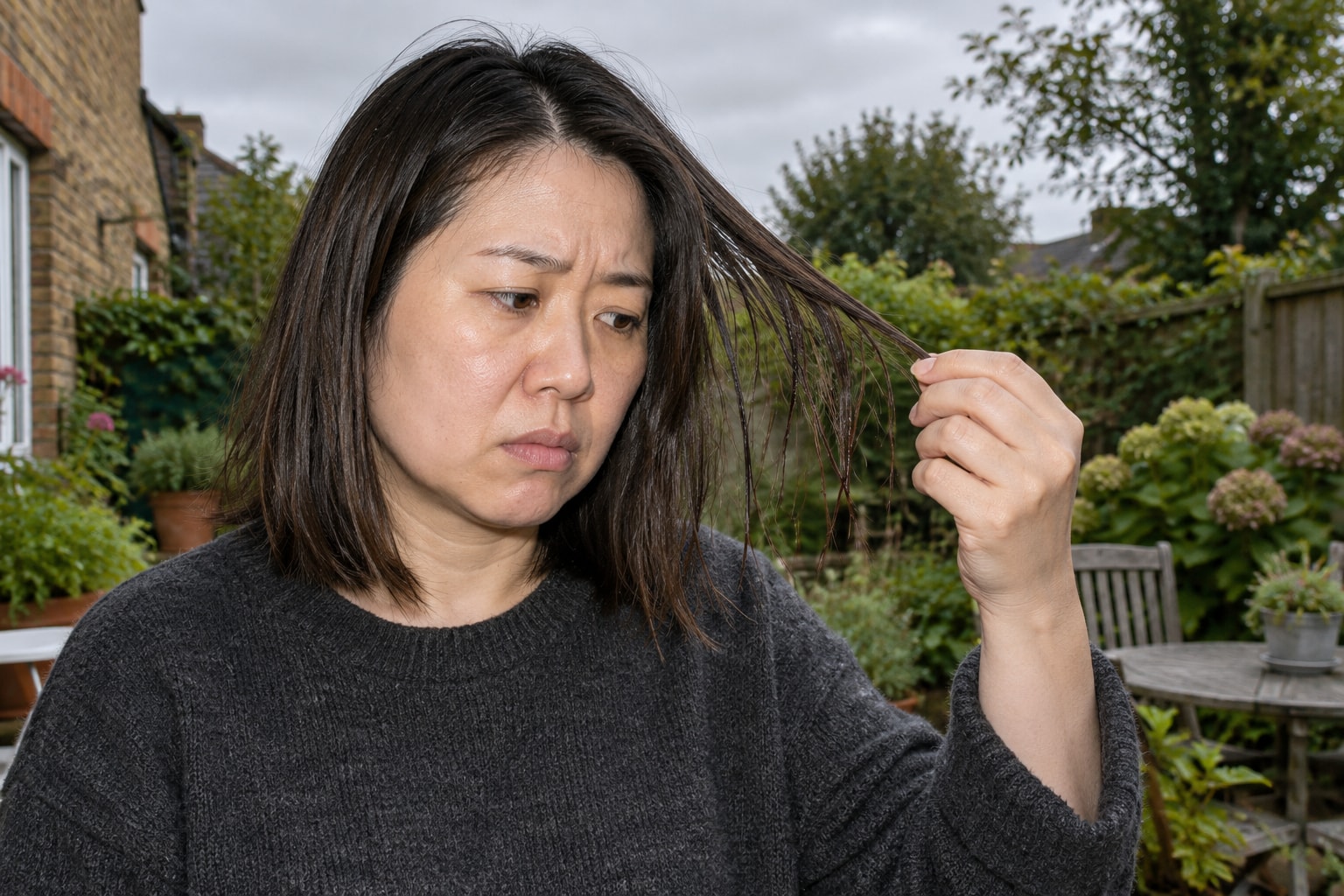
Why does my hair look stringy after washing? The strands may still be grouped by water, or a film of conditioner, scalp oil, or styling product may hold them together.
Wait until your hair is fully dry, then run two controlled washes that change only one part of your routine.
Why clean hair can still look stringy
"Stringy" describes a pattern, not a medical condition, and it doesn't prove damage or hair loss. Instead of spreading into separate strands, the hair sits in narrow sections with visible gaps between them.
Water causes the simplest version: using a model brush, José Bico and colleagues showed how capillary forces pull wet flexible fibers into bundles. Wet hair can therefore look flatter, thinner, and more separated even when its density hasn't changed.
Once the hair is dry, water is no longer the whole explanation. Product weight is worth testing next, but shaft damage or lower density can also leave visible gaps.
Shampoo removes scalp oil, skin debris, and product residue, while conditioner leaves agents that reduce friction and improve handling. D'Souza and Rathi describe both processes in their dermatology review of shampoos and conditioners.
That film is useful, but a rich formula, too much product, or conditioner placed near fine roots can take away lift. The result can look oily without feeling dirty.
The American Academy of Dermatology gives a useful starting point: apply shampoo mainly to the scalp. For fine or straight hair, place conditioner on the ends rather than the roots.
Find where the strands start grouping
The location narrows the cause faster than buying another product.
At the roots
Flat, shiny root sections make scalp oil, styling residue, or conditioner applied too high worth testing first. Check whether the look begins after a leave-in, oil, mask, or dry shampoo, and whether shampoo reaches the scalp beneath dense hair.
Through the lengths
If lengths feel unusually slippery and stay in narrow ribbons, test whether a rich conditioner is more than your hair needs.
If grouping disappears as the last damp areas dry, water was the main cause, so don't judge while the underside remains damp.
Mostly at the ends
Separated, rough ends may reflect weathering or breakage, because bleaching, frequent high heat, and rough handling can damage the hair shaft.
Run a two-wash test
A useful test starts with the stringy result from your normal routine, which becomes your baseline.
Choose one suspect based on where grouping starts. For roots, test conditioner placement or the single leave-in used closest to your scalp. For lengths, test the amount of one conditioner or styling product.
For wash one:
- Keep the wash interval, shampoo, water temperature, towel, and drying method unchanged.
- Change only your chosen variable by using less, moving it from the roots, or skipping that one product.
- Let the hair dry fully before assessing it.
Take one photo after drying, using the same part, room, camera distance, and light each time. Takwale and colleagues stress these controls in their photography guide, but you don't need to upload photos or use an attractiveness score.
If the hair looks less clumped and fuller, restore the original amount or placement for wash two. A return of the same stringiness makes that variable a plausible contributor.
One cycle isn't proof, so repeat it if the difference is small or the weather changed. If nothing changes, use a new two-wash pair to test the next suspect.
Don't remove five products at once, because that may help without showing which change mattered.
When a different product makes sense
Choose the next product from the test result, not from the word "stringy."
If the test implicates a leave-in, use less or choose a lighter finish. If conditioner is the trigger, keep it lower on fine hair. Dry, curly, or tightly coiled hair may need it along more of its length.
D'Souza and Rathi describe deep-cleaning shampoo as an option for frequent styling-product use. Follow its label, and stop if your scalp becomes sore or the lengths feel brittle. Stronger cleansing isn't a daily requirement.
If the roots become stringy as oil builds, wash when the scalp gets oily or dirty, following AAD guidance rather than an arbitrary schedule.
If the hair feels rough, snaps, or has many short broken pieces, focus on gentler handling. The AAD advises a wide-tooth comb on wet hair, low or medium dryer heat, and no rough towel rubbing.
Check for a density change, not one bad wash
Stringy hair and thinning hair aren't the same, because grouped strands can expose more scalp without any follicles disappearing.
Look for change over time. The AAD lists a widening part, a thinner ponytail, gradual thinning, a growing bald spot, and a receding hairline as common signs of hair loss. Compare a small series of dry-hair photos under the same conditions, not random bathroom snapshots.
See a dermatologist if changes continue. Go sooner for sudden bald patches, hair shedding in clumps, or loss with intense itching, burning, or tenderness. Scaly bald patches, open sores, or pus also need prompt assessment, because a photo can't identify the cause.
FAQ
Does stringy hair after washing mean it is greasy?
Not always, because oil, water, and conditioning products can all group strands into the same pattern. Check the hair only when dry, then remove one product at a time.
Can too much conditioner make hair stringy?
Yes, especially on fine or straight hair, because conditioner leaves a smoothing film by design. Use less, keep it away from the roots, and compare the fully dried result.
Should I wash stringy hair again immediately?
Only if you can feel obvious residue or missed a section of scalp. Otherwise, wait for full drying first. Rewashing wet hair won't tell you whether water caused the clumping.
Does stringy hair mean I am losing hair?
Stringiness alone doesn't show hair loss, so watch for a widening part, thinner ponytail, recession, or stable area becoming less dense. A dermatologist can examine the scalp if the change persists.