Quick answer
Dark gaps at the sides of your smile are usually normal buccal corridors, not holes between your teeth. They are the shadowed spaces between your back teeth and the corners of your lips. Their size reflects several features working together, so a selfie cannot prove that your upper jaw is too narrow. Orthodontic treatment may change them in selected cases, but removing every dark space isn't a sound treatment goal by itself.
The dark space has a name
Dentists call each side space a buccal corridor, which appears when your smile opening extends beyond the teeth the camera can see. The inner cheek then forms a darker background beside the last visible upper teeth.
Unlike a buccal corridor, a black triangle sits between two neighboring teeth, usually near the gumline. A buccal corridor sits outside the visible row of teeth, near a corner of the mouth.
This distinction matters because side shadows are a normal part of many smiles. If the dark area lies between teeth instead, ask a dentist to identify it.
Why your smile corners may look darker
Buccal corridor size does not come from one measurement. Zhang and colleagues linked smile width to the relationship between the upper arch, mouth, and face. The position and angle of the back teeth can also affect how much tooth surface you see.
Your lips add another variable: a broad opening around the same visible tooth row leaves more space at each side. A smaller or less stretched smile can leave less.
This is why “dark corners equal a narrow palate” is too simple. A narrow upper arch can contribute, but the photo does not show your bite or jaw width. It also cannot show whether the issue is dental, skeletal, or simply the way you smiled.
The gap can change from one photo to the next because a forced grin may pull your mouth corners farther outward. A tight crop gives the dark areas more visual weight, while added light can reduce the shadow.
Do buccal corridors make a smile less attractive?
The evidence is mixed, and the study design changes the answer.
Some experiments digitally widen or narrow the side spaces in one person's smile, and raters often prefer a middle range. Zhang's study used altered photos from one young woman and 53 judges. It found a wide range of acceptable changes, not one universal ideal.
Natural smiles tell a less tidy story. Janson and colleagues reviewed 20 studies and found that buccal corridor size alone did not appear to affect ratings in real-smile studies. The review also found no predictable smile penalty from four-premolar extraction when treatment was properly indicated.
Wei and colleagues later tested 188 standardized smile images from Chinese adults aged 20 to 35, rated by 22 laypeople. Corridor size and left-right symmetry had no clear link with scores. Which back teeth and how much back gum showed mattered more in that sample.
Those findings have limits because the Wei study covered one age range and one population. Ratings also depend on the rater and the image used. The results do not set a percentage that separates a “good” smile from a “bad” one.
Check the gap without letting the camera decide
Use repeatable photos before treating a single image as evidence, so you can see whether the feature stays stable under normal conditions.
- Stand in soft light facing a window. Keep flash off so it cannot fill the side shadows differently.
- Place the camera near face level, about one metre away, and keep that distance each time. Do not use a tight mouth crop.
- Record a short video while your expression moves from neutral to a natural smile.
- Save one relaxed full-smile frame. Then repeat the setup on another day.
- Compare the whole smile, not the dark pixels alone.
Video helps because smiles move. Wei's team selected standardized full-smile frames from dynamic recordings rather than asking participants to hold a strained grin. Your home check will not measure anatomy, but it can expose an effect caused by timing or lighting.
If the corridors look different across frames, lip movement and timing are probably part of what you saw. If they remain similar, you have documented a stable feature, but neither result diagnoses a narrow palate.
You can keep this comparison on your own device. You do not need to upload a smile photo to check whether the spaces remain consistent.
What orthodontic treatment can change
Braces, aligners, and prescribed expansion can change tooth position or upper-arch width, but that does not promise smaller corridors.
Claims about extraction also need care. Janson's review found no predictable difference in how extraction and nonextraction smiles looked as a whole. That does not prove both plans suit every mouth, but side shadows alone cannot tell you that extractions harmed a smile.
A palatal expander is a medical device, not a smile-width accessory. The American Association of Orthodontists says expanders treat diagnosed problems such as crossbite, severe crowding, or impacted teeth. Treatment depends on age, skeletal maturity, and the problem, so adult options differ from those used during growth.
An orthodontic assessment makes sense when you also have a crossbite, crowding, chewing trouble, or a recent unwanted change after treatment. Ask the orthodontist to name the diagnosis. Then ask what change is expected, which risks apply, and what happens if you do nothing.
Seek a second opinion if the plan targets appearance without explaining your bite. A clinician should assess your teeth, gums, jaw relationship, and goals together. A cropped selfie is not a treatment plan.
Skip DIY widening methods
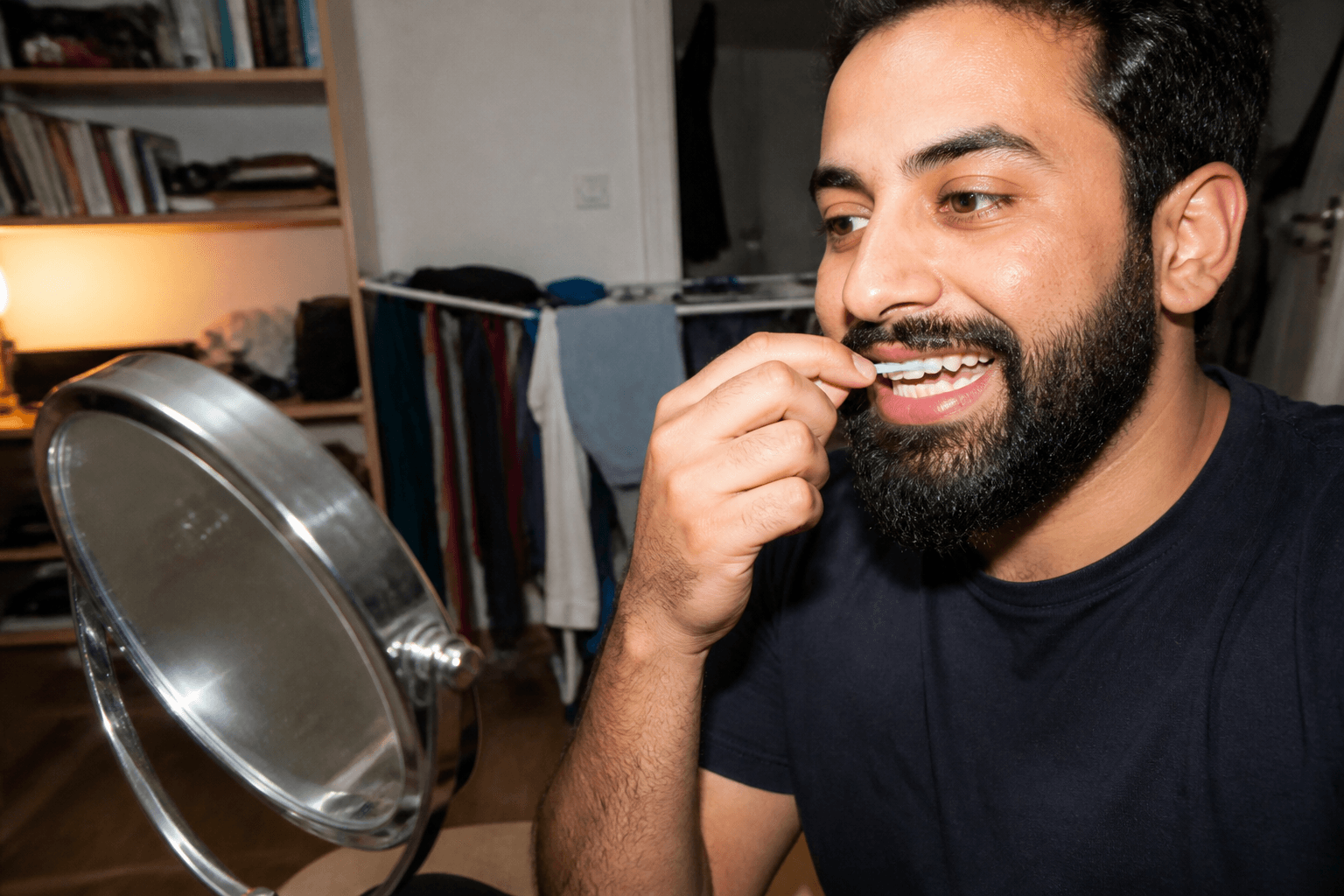
Do not use thumb pulling, homemade expanders, or unsupervised orthodontic appliances to chase wider smile corners. They apply force without a diagnosis or clinical monitoring. Teeth can shift in unwanted directions, and repeated pressure can disturb your bite.
Forceful smiling is not a fix because it may enlarge the corridor by spreading your lips beyond their natural position. Use a relaxed expression for photos and leave structural questions to a qualified dentist or orthodontist.
FAQ
What are the black spaces at the corners of a smile called?
They are usually called buccal corridors, or lateral negative spaces. Each one sits between the visible upper back teeth and the inner cheek or lip corner. They are not the same as black triangles between adjacent teeth.
Do dark smile corners mean I have a narrow palate?
No. A narrow upper arch can be one factor, but lip width, tooth angle, visible back teeth, and expression also shape the corridor. An orthodontist needs to examine your bite before calling the palate narrow.
Can braces or Invisalign remove buccal corridors?
They may change the spaces by moving or angling teeth, but the result is not guaranteed. Treatment should address a diagnosed bite or alignment problem, not a target gap copied from a photo.
Can mewing or thumb pulling widen my smile?
There is no reliable clinical evidence that these DIY methods safely widen an adult smile. Repeated, uneven pressure can disturb teeth or your bite. If smile width worries you, get an orthodontic assessment instead of trying to move teeth yourself.