Quick answer
Why does composite bonding look bulky? Added resin may have changed the tooth's width, length or front contour more than you expected. If floss catches, your bite feels different or an edge feels sharp, ask your dentist to review it rather than filing it yourself.
Why added resin can change tooth proportions
Composite bonding works by molding tooth-colored resin onto a natural tooth. Dentists use it to repair chips, close spaces, change color or alter a tooth's shape and size. The resin is hardened, adjusted and polished during the visit.
That added material has to go somewhere, and closing a space can change a tooth's apparent width or projection. This geometric trade-off does not prove that anything went wrong.
Small contour choices can still change what you see. Facial line angles are the transitions between the front and side surfaces of a tooth. A 2022 clinical paper by Kallala and colleagues explains that these angles shape its perceived width. The paper is a case report, not a comparison trial, but the optical principle helps describe the concern.
Form and contour are only part of the check. Contact between teeth, surface texture and color can each affect how a restoration fits into the smile.
Does it look bulky, feel wrong, or both?
Feeling large and looking broad are different concerns. Cleveland Clinic notes that short-term sensitivity can occur after bonding. A sharp edge or an odd bite needs a dentist's check.
Once the resin is cured and polished, waiting will not remove visible width. An appearance-only concern can go to your planned review. Contact the dentist sooner if floss is blocked, your bite changes or an edge is sharp.
Separate what you feel from what you can observe:
- Look: the tooth appears wider, longer, flatter or farther forward at a normal viewing distance.
- Contact: floss will not pass, shreds repeatedly or catches at the same spot.
- Bite: one bonded tooth seems to touch first, or your jaw shifts as you close.
- Surface: an edge feels sharp or a patch stays rough.
These clues do not tell you how much material should come off, but they give your dentist a better starting point. Cleveland Clinic advises calling if a bonded tooth has a sharp edge or feels odd when you bite.
Check the result without letting your camera decide
Camera distance, head position and lighting all change a smile photo. Do not judge a dental result from one flash image taken a few inches away.
A 2021 laboratory study photographed 30 maxillary casts with an iPhone X at distances from 16 to 32 centimeters. Front-tooth measurements did not differ across those tested distances. Only premolar widths differed at 16 and 20 centimeters. The controlled model setup cannot tell you how a casual selfie will render your smile.
Use photos as a record, not a diagnosis:
- Clean the lens and use the rear camera if you can.
- Stand in even light and keep your head level.
- Step back enough to include your whole face, then crop the image.
- Take a front view, a slight side view and a relaxed smile.
- Compare with a before photo taken at a similar distance and angle.
Check the mirror from normal conversation distance as well. A close photo can document a small area, but it cannot assess your bite or confirm marginal fit.
A five-minute check before your review
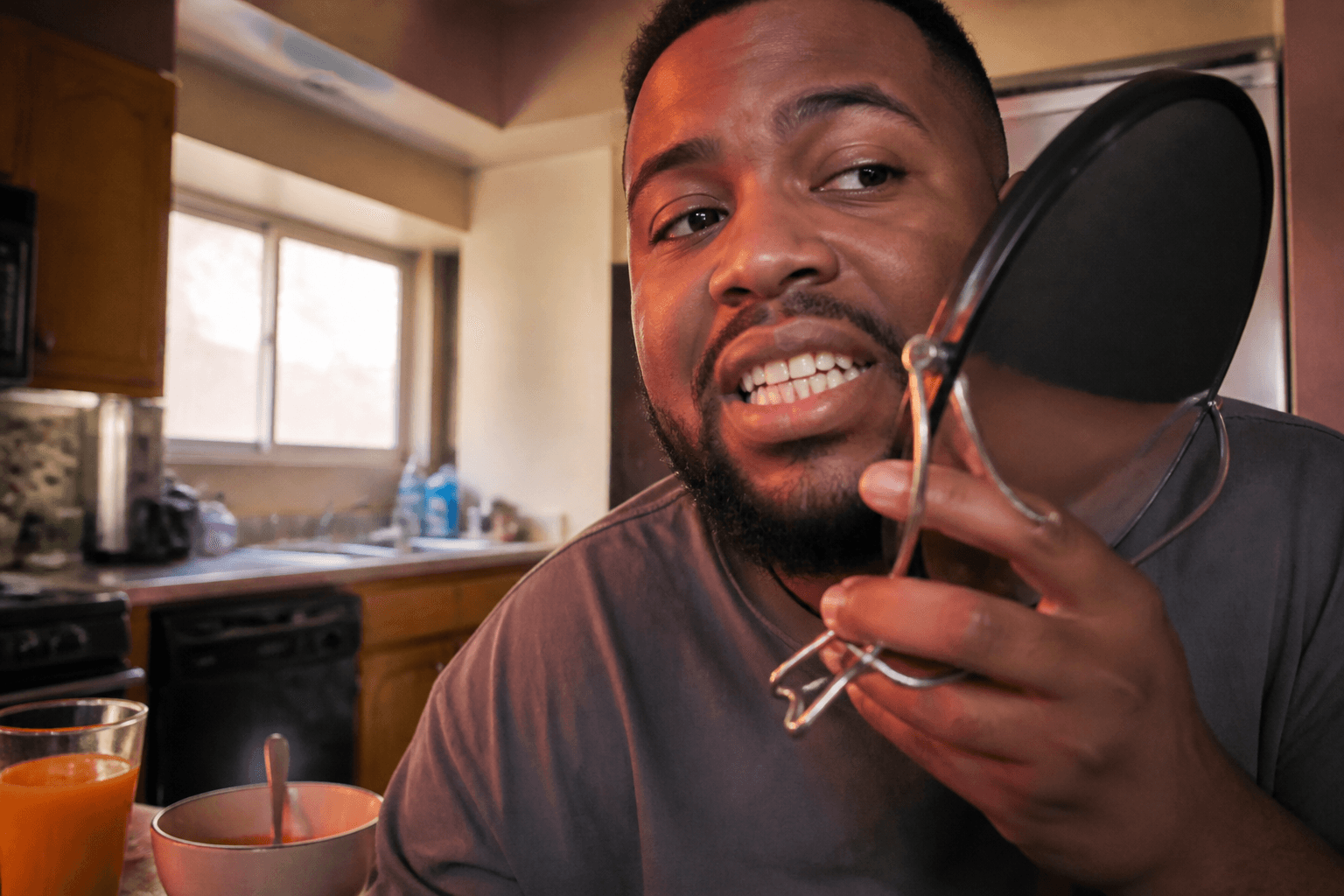
Start with clean teeth and neutral light. Look once from the front and both slight side angles. Write down the exact feature that bothers you, such as “the left front tooth looks wider through the middle.”
Next, floss each treated contact once with gentle pressure. Do not snap or force floss through a closed contact. Then close your teeth slowly without clenching and notice whether one spot meets first.
Stop there. Each new angle creates a different comparison, so it cannot show whether the tooth changed. A short note and three consistent pictures are more useful at an appointment.
What your dentist should assess
“Bulky” is not a dental diagnosis. The revised FDI criteria give dentists more specific parts of a restoration to assess. These include form and contour, contact between teeth, bite and wear, marginal fit, surface texture and color match.
Your dentist can compare the bonded tooth with its neighbor, check floss contact and examine your bite. They can also decide whether the problem is extra contour, surface finish, tooth position or a mismatch between your expected and possible result.
Finishing is skilled work. A clinical checklist by Vargas and Margeas treats contouring and polishing as a planned sequence for creating correct anterior tooth anatomy. It is not the same as simply buffing the surface until it feels smooth.
A small professional adjustment may be enough when one area has excess resin. A larger shape problem may need repair or replacement instead. The FDI framework separates monitoring, minor professional refinishing, repair and replacement according to the clinical finding.
What to say at the appointment
Name the visible or functional problem before asking for a treatment. This keeps the conversation focused on what needs checking.
You could say:
“From a normal viewing distance, these two bonded teeth look wider and flatter than my before photo. Floss catches between them, and the right tooth touches first. Could you check the contour, contact and bite before we discuss reshaping?”
Use only the details that are true for you.
Bring your before images or approved mock-up if you have them. Tell the dentist whether the concern appears in person, in consistent photos or only in close selfies. These are different problems.
In one single-center study, 56 patients assessed 106 in-service anterior composite restorations. Color was the most frequent complaint, followed by anatomical form. That sample cannot show how common bulky bonding is in the wider population.
Do not file composite bonding at home
Do not use a nail file, abrasive strip, sandpaper or rotary tool on bonded teeth. Form, contact, marginal fit, surface texture and bite are linked clinical checks. Removing material without an examination can alter any of them.
A dentist can examine the margin and bite, adjust the indicated area and repolish the resin. If the proposed change is large, ask what will be removed and whether a mock-up or second opinion would help.
Be cautious if anyone jumps straight from minor bulk to irreversible treatment. Cleveland Clinic describes bonding as a minimally invasive option, while porcelain veneers require enamel removal. A second opinion is reasonable before healthy enamel is cut for an aesthetic concern.
FAQ
Does composite bonding get less bulky with time?
The cured resin does not shrink, so a visibly wide or prominent contour will not thin itself. Ask for a review if the shape bothers you or affects flossing or your bite.
Can a dentist make composite bonding thinner?
A dentist may be able to reshape and polish a limited area of excess resin. Whether that is safe depends on the tooth underneath, the bonding margin, the contact and your bite. Some designs need repair or replacement rather than more trimming.
Should floss pass between bonded teeth?
Floss should normally pass between teeth with controlled resistance. If it will not pass, shreds repeatedly or catches in one place, do not force it. Ask the dentist to check the contact and margin.
Is bulky composite bonding an emergency?
An appearance concern alone usually belongs at a review appointment. Call your dentist sooner if an edge is sharp, a tooth feels odd when you bite or the bonding chips. Those signs need a clinical check, not a home adjustment.