Quick answer
Can a beard straightener damage your beard? Yes. Too much heat, long contact, or repeated passes can weaken the hair shaft and cause roughness, split ends, and breakage.
Direct studies of heated beard brushes are scarce. Most evidence comes from scalp-hair experiments, so no exact temperature is proven safe for every beard. Use the lowest setting that works, style only fully dry hair, and keep passes brief.
What heat does to beard hair
A beard hair has an outer cuticle around an inner cortex. Heat removes water and changes the keratin structures that help the shaft hold its shape. At higher doses, those changes stop being temporary.
One laboratory study found small, reversible changes below 140°C and deeper, irreversible changes above that point. That doesn't make 139°C a safe target. Device accuracy, contact time, repeated passes, and previous damage change the dose each hair receives.
Tests with flat irons also found protein damage, lower water retention, rougher cuticles, and more breakage after combing. Those irons ran above 200°C, so their results don't map directly onto a heated beard brush. They do show why maximum heat isn't a harmless shortcut.
Beard hair is not the same as scalp hair. A review found that beard shafts are usually thicker, stiffer, and more irregular in shape. They also have more cuticle layers. That may explain why a coarse beard resists straightening, but it doesn't prove that beard hair tolerates more heat.
Signs your beard is getting heat damaged
Heat damage builds in the shaft, so look for a change from your own baseline. The clearest warning signs are:
- A rough or straw-like feel after washing out every product
- More split ends, frizz, or snapped short hairs
- Dull sections that no longer reflect light evenly
- Redness, tenderness, or burning where the tool touches skin
One bad styling session won't always produce visible damage. Repeated heat can make the pattern clearer over several weeks. Products may smooth the surface for a day, so judge your beard when it is clean and uncoated.
Breakage can make a beard look less dense even when the follicles are still growing. A smooth bare patch, root-level shedding, or an inflamed rash needs a different explanation. Stop using the tool and see a dermatologist if those changes persist.
A lower-damage way to use a beard straightener
Start with fully dry hair
Do not run a heated brush through a wet or damp beard. The American Academy of Dermatology gives the same advice for flat irons. Laboratory work also found more damage when hot irons touched hair coated with a wet, water-based spray.
Wash only when your normal routine calls for it, then dry the beard fully. Detangle gently before switching on the tool. This reduces the repeated hot passes needed to pull through knots.
Use the lowest setting that gives a visible result
Start at the lowest setting. Make one controlled pass through a small section, then check the result before doing more. If nothing changes, increase one step next time instead of chasing the result with repeated passes.
There is no universal safe number. The temperature at the heating element is not always the temperature reached inside each hair. Shaft thickness, product residue, contact time, and device calibration all matter.
Keep the tool moving and off your skin
A heated brush should shape the hair, not press into your face. Keep it moving, avoid holding it on one spot, and stop if your skin feels hot. If the bristles cannot clear your skin on a short beard, the tool is a poor fit for that length.
Use it less often
The AAD advises low or medium heat on dry scalp hair and limits flat irons to every other day. A beard straightener is a different tool, so that schedule is not proof of safety. Treat it as an upper limit, not a goal.
Save heat for days when it changes the result enough to matter. On other days, try a brush with cool or low-temperature moving air. In one scalp-hair test, damage rose with dryer temperature. Holding the dryer 15 centimetres away and moving it caused less damage than close, hotter drying.
Beard oil is not automatically heat protection
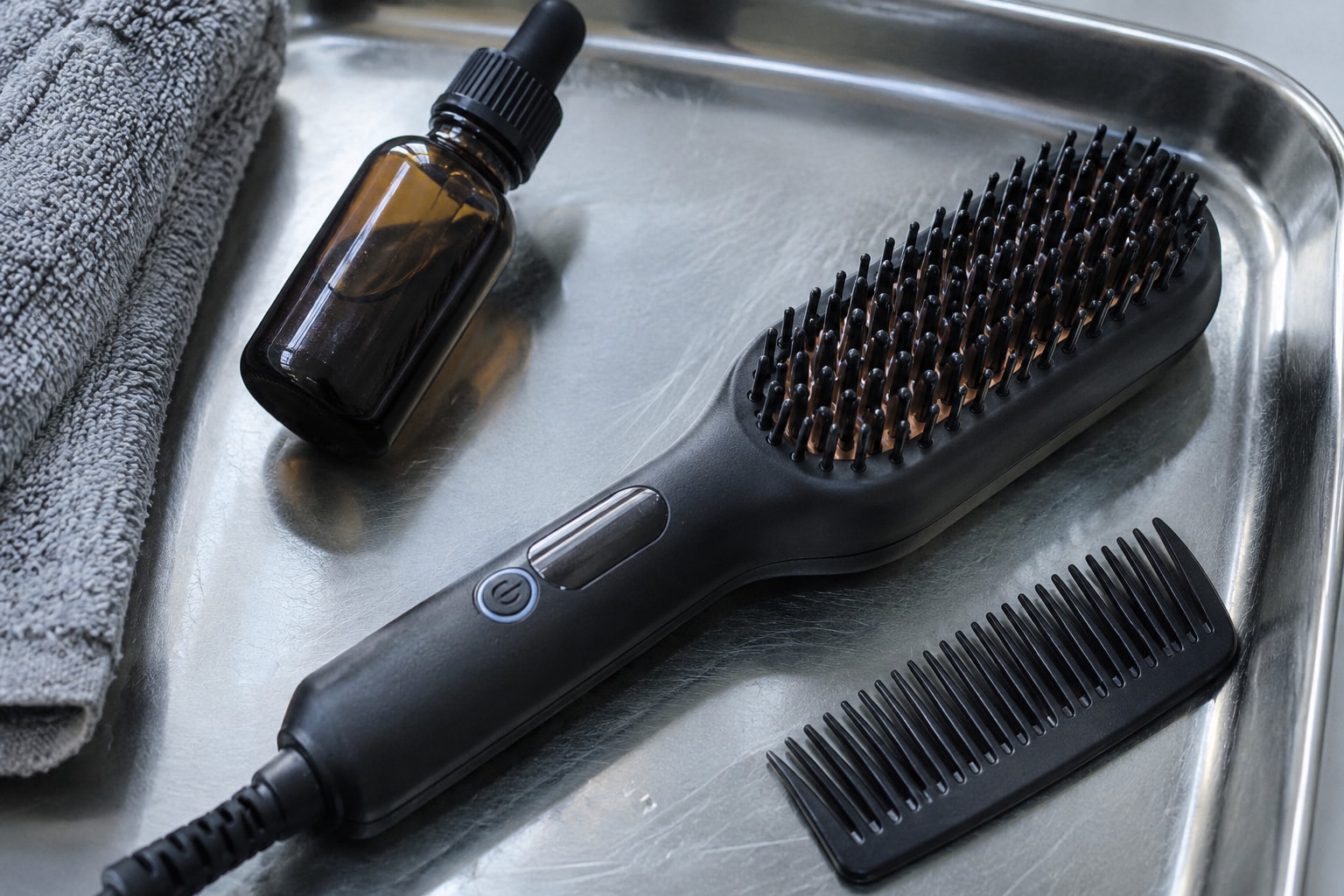
Some heat protectants can reduce damage, but the formula matters. One flat-iron study found that selected film-forming polymers reduced keratin changes and breakage. It did not test ordinary beard oil, balm, or every product sold as a protectant.
An oily feel is not evidence of thermal protection. Use a product only if its label supports heat styling and facial use. Follow its drying instructions and the straightener manufacturer's directions. Do not place a fresh wet layer between hot bristles and hair.
Test whether the tool actually helps your appearance
Do a short comparison before turning heat into a daily habit. Take front and side photos before and after styling. Keep the camera, distance, window light, expression, and beard length the same.
Record the setting and number of passes. Check the beard again after the next wash, when styling products are gone. You are looking for a clear shape improvement without rising roughness, breakage, or skin irritation.
If the gain only appears under one bathroom light, it may not justify repeated heat. A trim, shorter outline, or low-air brushing may give a similar result with less exposure.
FAQ
Can I use a beard straightener every day?
Daily use raises cumulative heat exposure, and direct beard-brush safety trials are missing. Use it less often when possible, with fully dry hair and the lowest effective setting. Stop if roughness, split ends, or breakage increase.
What temperature is safe for a beard straightener?
No temperature is proven safe for every beard and device. One scalp-hair experiment found irreversible structural changes above 140°C, but that is not a personal safety threshold. Start low, limit contact, and avoid repeated passes.
Can I put beard oil on before straightening?
Do not assume regular beard oil protects against heat. Use it before styling only when both the oil and tool instructions allow that use. A labeled heat protectant may help, but evidence depends on its ingredients.
Will heat-damaged beard hair grow back normally?
Heat usually damages the visible shaft, which must be trimmed or replaced by new growth. Stop the tool if it burns your skin. See a dermatologist for lasting pain, blistering, a rash, or patchy loss from the roots.