Quick answer
Why does gray hair turn yellow? Heat can change proteins in white strands, while products or outside chemicals can leave a colored film. Light exposure may also shift color, but laboratory results vary with the wavelength and hair sample.
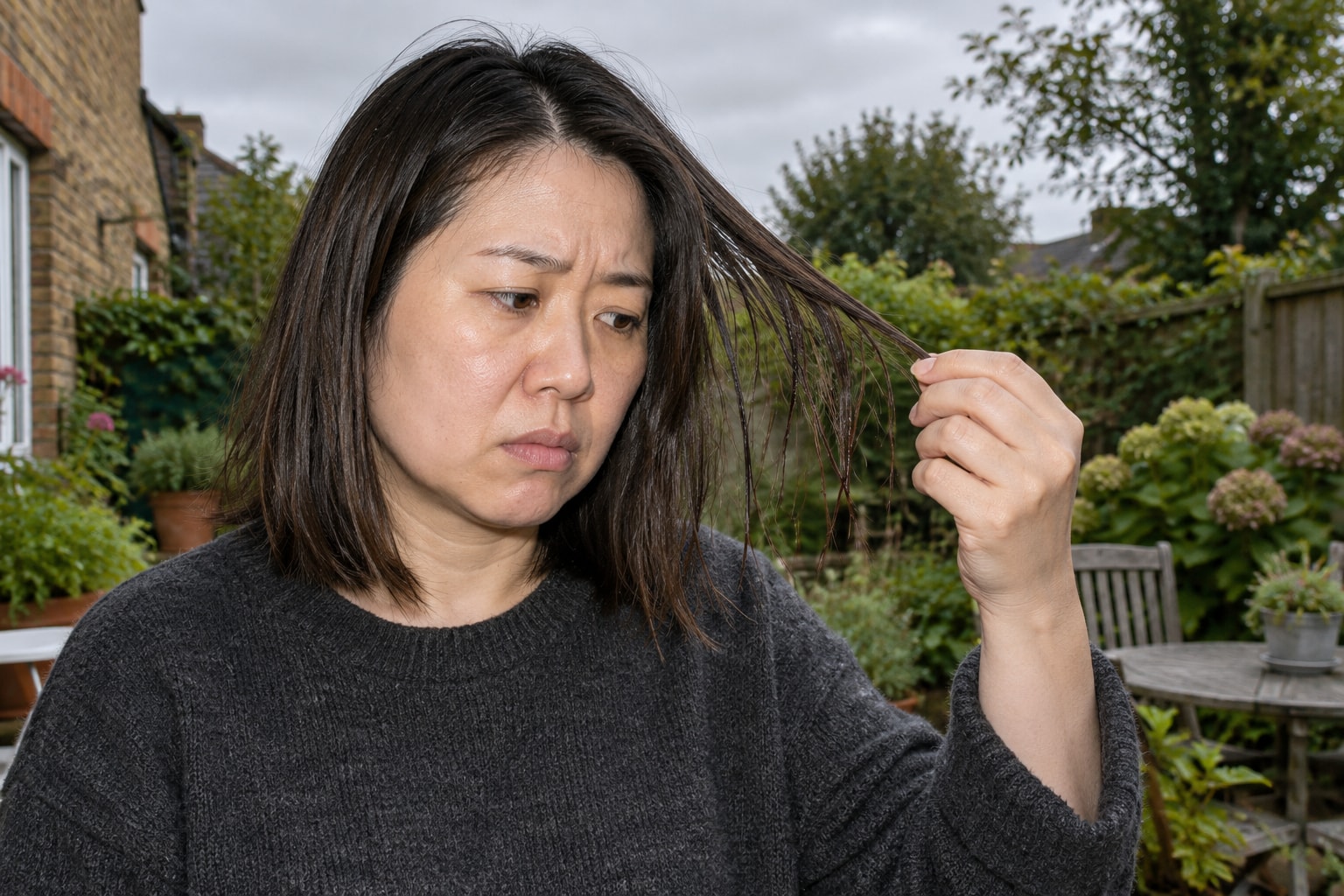
Check where the yellow starts before trying to remove it. Yellow lengths with clean gray roots point to an exposure after growth, not your hair “turning blonde again.”
Why gray hair shows yellow so clearly
Gray hair is a mix of pigmented and unpigmented strands. White strands contain little or no melanin, the pigment that gives hair its color. That makes small chemical changes and surface stains easier to see.
The yellow may sit on the strand, or it may come from a change within its proteins. Those causes behave differently. Surface residue may wash out. Heat-related oxidation of the hair shaft cannot simply be washed away.
Most evidence comes from laboratory hair samples and a few case reports. Researchers can prove that an exposure changes hair color under test conditions. They cannot tell you how often that cause explains yellow gray hair at home.
Read the pattern before treating it
Look at your hair in indirect daylight, beside a white towel or sheet of paper. Warm bathroom bulbs can make clean silver hair look cream or gold.
Then check three details:
- New gray roots but yellow lengths suggest heat, light, smoke, or product exposure after the strand grew.
- A cast that appeared after one new product points first to that product.
- Yellowing strongest where a hot tool touches supports heat as the cause.
Take a photo with the same light and camera settings. This gives you a fair comparison after two or three washes. A photo can record color, but it cannot identify a chemical deposit.
Heat has the clearest direct link
A 2014 laboratory study exposed two gray-hair samples to light and heat. Heating at 81°C made the white fibers in both samples more yellow. The amount differed between samples. There is no universal temperature where everyone's gray hair suddenly changes color.
That test did not copy a quick pass with a hair dryer or straightener. Exposure time, tool temperature, strand moisture, prior damage, and product residue all change what happens. Still, a yellow band after repeated hot-tool use is a useful clue.
For two weeks, stop the tool that contacts the yellow area. If you still use heat, choose the lowest setting that works and keep the tool moving. Don't repeatedly press the same section.
A heat protectant cannot reverse existing yellowing. Research on stopping this color change during real styling is limited, so lower heat remains the measurable step.
Sunlight is more complicated than the usual claim
It is common to blame all yellowing on ultraviolet light. The experiments do not give such a simple answer.
In a 2007 study, white hair became less yellow after full and UVB-filtered lamp exposure. Infrared radiation produced yellowing. The 2014 experiment also found different results according to the light source and hair sample.
Another laboratory study examined free radicals in natural white hair exposed to UV. Added copper increased the reactions researchers measured, while some antioxidants and metal chelators reduced them. That shows a possible chemical pathway. It does not prove that a particular spray, shower filter, or supplement prevents yellow hair in daily life.
If the exposed top layer yellows more than covered hair, use a physical barrier. A hat is a simple test. It also avoids relying on an unproven hair-SPF claim.
Products and deposits can leave a yellow film
Compare every product that touches your hair. Clear in the bottle does not always mean colorless on white strands. Oils, serums, smoke, self-tanner, and pigmented styling products can leave a visible cast.
Rare medical reports show how specific the trigger can be. One paper described yellow hair after selenium sulfide 2.5% shampoo and after dihydroxyacetone, the coloring ingredient in self-tanner. Two cases do not make those products common causes. They do show why timing matters.
Hard water is often blamed online. Calcium, magnesium, copper, and other metals can interact with hair, and copper affected UV reactions in the laboratory. Yet the research does not show that hard water explains most gray-hair yellowing.
Check your local water report before buying equipment. A shower “filter” may remove chlorine but leave hardness minerals unchanged. Check its performance data for the substance you want removed.
Use a one-change removal test
Start with ordinary shampoo and a thorough rinse. Pause tinted oils, serums, sprays, and self-tanner near the hairline for two or three washes. Clean brushes and hot-tool plates so they do not put residue back.
If the yellow remains and your water report shows high minerals, try one labeled chelating shampoo. Follow its directions and condition afterward if needed. Do not repeat strong cleansing until the hair feels rough.
Purple shampoo works differently. Violet pigment can make yellow look less visible through color contrast. It does not remove every deposit or repair an oxidized shaft.
Test it on a hidden section first. Porous white hair can grab violet unevenly. Use the shortest label time at first, then inspect the fully dry strand in daylight.
Avoid homemade bleach, peroxide, baking soda, and laundry brighteners. Gray hair may already be weathered, and these treatments can add roughness or breakage. A colorist can distinguish residue from permanent shaft change and tone the hair more evenly.

When the pattern needs a professional check
Book a stylist if the color appeared after salon processing, forms sharp bands, or survives careful clarifying. Bring a list of products and heat tools rather than guessing at the cause.
See a clinician if yellowing arrives with scalp inflammation, hair loss, brittle nails, or another new body change. Yellow hair alone is usually an appearance issue. A wider change deserves an assessment instead of more cosmetic treatment.
FAQ
Can yellow gray hair turn white again?
Surface residue may wash or chelate away. Violet toner can temporarily neutralize the remaining yellow. A shaft changed by heat or oxidation will not biologically repair itself, so that section must grow out or be cut away.
Does purple shampoo remove yellow from gray hair?
It mainly deposits violet color, which makes yellow less obvious. It is not a universal cleanser. Overuse can leave porous sections lavender or make dry hair feel rough, so start with a hidden strand and the label's shortest timing.
Does hard water make gray hair yellow?
Metals can collect on hair and copper can affect light-driven oxidation in laboratory tests. That makes water a possible contributor, not a diagnosis. Check the water report and use one controlled chelating wash before buying a softener or filter.
Can a flat iron turn white hair yellow?
Heat yellowed white hair in a laboratory study, so repeated hot-tool contact is plausible. Real styling differs from that experiment. Lower the setting, keep the tool moving, and compare untreated new growth with the lengths.