Quick answer
Rosemary oil may help some people with early pattern hair loss, but the evidence is still limited. One small trial found higher hair counts after six months, while a newer trial tested rosemary blends rather than rosemary alone.
That is promising, but it doesn't prove rosemary matches minoxidil. If you try it, set modest expectations and get unusual hair loss checked.
Does rosemary oil help hair growth in human studies?
The strongest direct evidence comes from Panahi's 2015 trial of 100 men aged 18 to 49 with male pattern hair loss.
Researchers randomly assigned 50 men to a standardized rosemary lotion and 50 to topical minoxidil 2%. Each group applied 1 millilitre twice daily for six months, and two dermatologists assessed standardized scalp photographs without knowing each treatment.
Neither group had a statistically significant hair-count change after three months, but average counts had risen in both groups by month six. The difference between the groups wasn't statistically significant at either checkpoint.
Scalp itching increased in both groups and occurred more often with minoxidil. The trial found no meaningful changes in dandruff, dry hair, or greasy hair.
This result supports a possible effect, but it doesn't show that every bottle labelled rosemary oil will work.
Why doesn't that trial prove rosemary equals minoxidil?
“No statistically significant difference” isn't the same as proof of equal results. A proper equivalence study sets a margin in advance and enrolls enough people to test it, but this trial wasn't designed that way.
There was no placebo or untreated group, so you can't separate treatment effects from unrelated changes cleanly. Hair counts can shift with normal growth cycles or measurement error.
The comparison was also minoxidil 2%, so it does not settle comparisons with other strengths. All participants were men from one clinic in Iran, with naturally dark hair and crown-pattern thinning.
Those details narrow the result, which doesn't establish the same benefit for women, older adults, temple recession, or other forms of hair loss.
What did the newer rosemary hair study add?
Patel and colleagues enrolled 90 adults in a 2025 randomized trial. Eighty-two finished the 90-day study.
The trial compared two commercial blends with coconut oil. The first was a 10-component formula that included rosemary and lavender. The other paired rosemary with castor oil.
The authors reported that both rosemary blends improved several hair measures compared with coconut oil. The signal is useful, but it can't reveal what rosemary did by itself. Other ingredients or the full formulas could have affected the results.
Participants reported thinning or hair fall, but the study didn't require a confirmed pattern hair loss diagnosis. That makes the findings harder to apply to a specific condition.
The product maker funded the study and employed one author, which doesn't erase the result but makes independent replication more valuable.
Almutairi and colleagues called rosemary promising in a February 2026 narrative review. They found that strong clinical evidence was still unavailable and asked for larger controlled trials with clearer formulas and outcomes.
We still lack a large, independent trial of a clearly defined rosemary product.
Which type of hair loss might rosemary oil help?
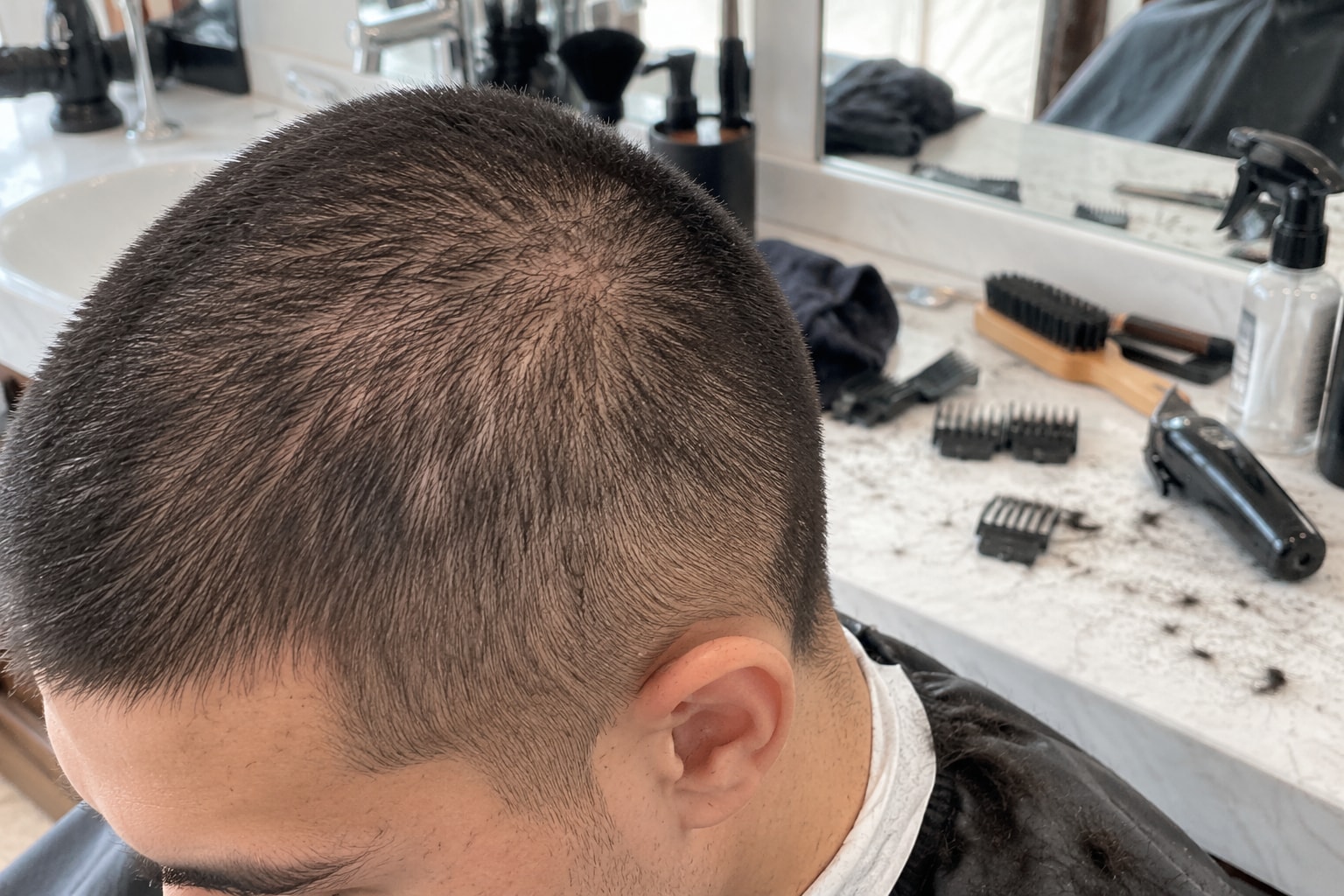
The 2015 trial studied androgenetic alopecia, which usually causes gradual, patterned thinning. Men often notice recession at the temples or thinning around the crown. Women more often notice a wider part and lower density across the top.
Rosemary oil hasn't been shown to treat every cause of shedding. It shouldn't be your first response to sudden bald patches, rapid shedding, broken hairs, or scalp pain. Burning, marked redness, thick scale, sores, or pus also need medical attention.
Those signs can point to conditions that need a diagnosis and targeted care, while an oil experiment may delay that care.
Take clear baseline photos if the change is slow and patterned. If you can't tell what pattern you have, ask a dermatologist or GP before choosing a treatment.
Is rosemary oil better than minoxidil?
Current evidence doesn't support that claim. Minoxidil has a much larger research base, while rosemary has one small direct comparison with 2% minoxidil. In the United States, topical minoxidil is approved for hair loss in both men and women.
The American Academy of Dermatology says topical minoxidil can reduce loss and stimulate growth, with results often assessed after four to six months. Continued use is usually needed to keep gains.
Rosemary doesn't become the better choice just because minoxidil irritates your scalp. Both can cause reactions. Discuss persistent irritation with a clinician, and don't stop prescribed treatment because a short video favours a plant oil.
Using rosemary and minoxidil together hasn't been well tested, while combining them could make irritation harder to trace. Ask your prescriber before adding rosemary to a treatment plan.
Does rosemary oil block DHT?
Claims about DHT run ahead of the human data, although dihydrotestosterone does drive follicle shrinkage in androgenetic alopecia. That makes it a tempting explanation for any product marketed for pattern hair loss.
The rosemary trials didn't measure scalp or blood DHT, so they can't support that claim. Proposed effects on circulation, inflammation, and androgen pathways come mainly from laboratory work and theory. A plausible mechanism can't replace a clinical result, yet “natural DHT blocker” sounds stronger than the evidence.
Rosemary oil shouldn't be treated as a proven substitute for medicines that directly target androgen pathways.
Are rosemary oil, rosemary water, and shampoo equivalent?
They aren't equivalent. The name rosemary covers products with different ingredients, strengths, and contact times, so their results can't be pooled as one treatment.
The 2015 researchers used a lotion standardized to contain at least 3.7 milligrams of 1,8-cineole per millilitre. Most retail oils don't match that description, and many labels don't state comparable chemical details.
A leave-on scalp serum comes closer to the tested format than a shampoo that washes away within minutes. Even then, matching the format doesn't guarantee matching the formula or result.
Rosemary water is another product entirely. Boiling leaves in water doesn't recreate the lotion, and no human trial discussed here tested that method for regrowth.
Ignore claims that a stronger smell means a stronger hair treatment. Scent doesn't tell you the dose, purity, or effect on follicles.
How should you try rosemary oil safely?
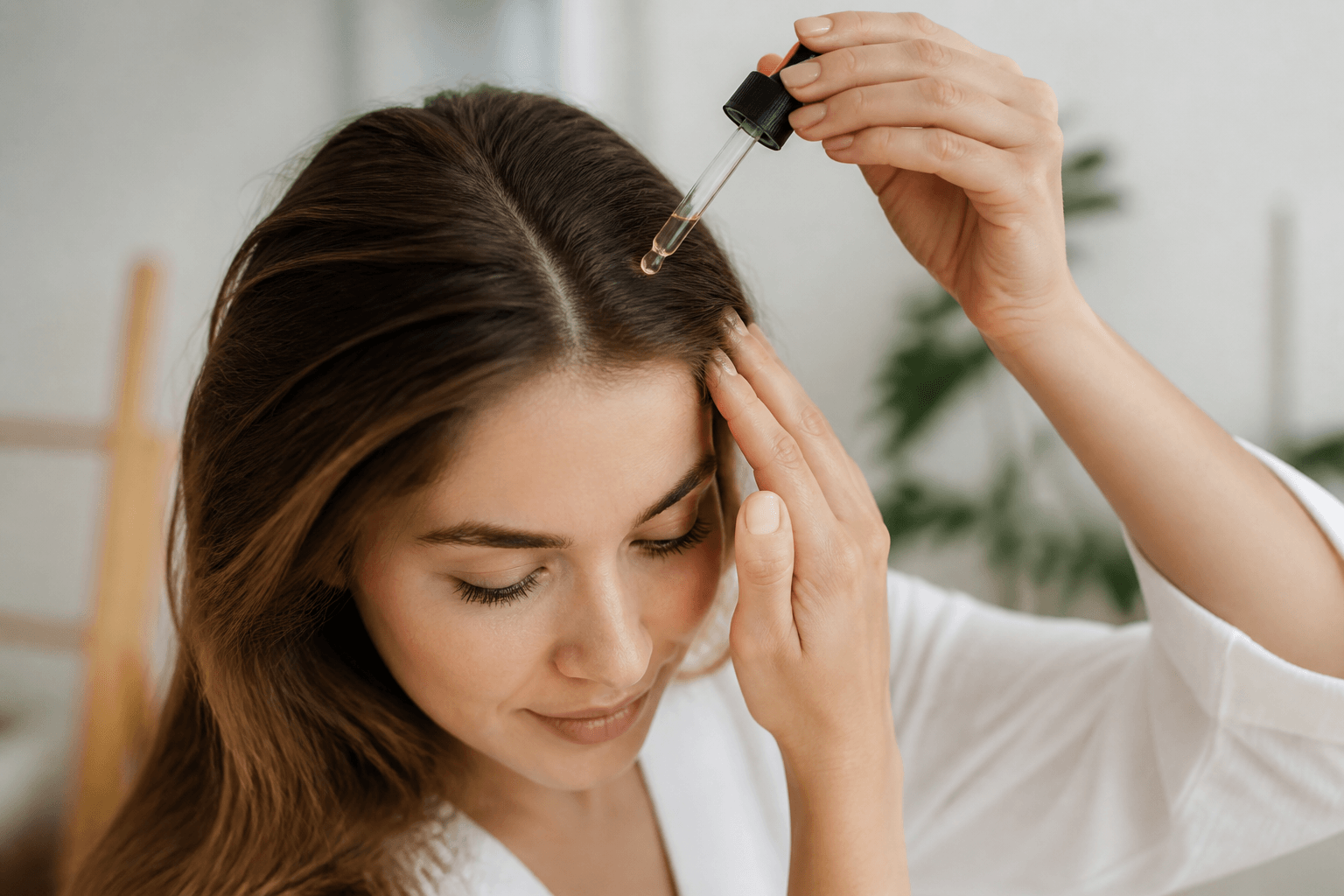
Use a simple, controlled test that protects your scalp and makes the result easier to judge.
- Choose a ready-made, diluted scalp product with a full ingredient list. Pure concentrated oil is more likely to irritate skin.
- Follow the product label. Don't copy a random number of drops from a video because strengths and formulas vary.
- Test a small area first. Stop if you develop burning, lasting redness, swelling, or a worsening itch.
- Keep it away from your eyes and don't apply it to broken, sore, or inflamed skin.
- Change one treatment at a time. Otherwise, you won't know what helped or what caused a reaction.
The 2015 trial used a standardized lotion twice daily. No strong trial has established the best schedule or number of drops for shop-bought oils.
Don't swallow concentrated rosemary oil, and store it away from children. Wash your hands after scalp application.
How long does rosemary oil take to work?
Three months was too early in the main trial because hair counts didn't change then. The first measured improvement appeared at six months.
If you try rosemary oil, judge it over months rather than days, but stop if your scalp reacts or hair loss speeds up. Waiting six months shouldn't mean ignoring a worsening condition.
Use the same photos each month: dry hair, the same part, the same room, and the same camera distance. Capture the hairline, both temples, and crown because hair length, lighting, wetness, and styling can create a false before-and-after.
Keep those photos private by storing them on your device or checking how a tracking service handles uploads.
A practical decision rule
Rosemary oil is reasonable to test when your thinning is gradual, your scalp is healthy, and expectations are modest. Pick one diluted product and track it for up to six months.
Skip the experiment and seek care when loss is sudden, patchy, painful, inflamed, or rapidly worsening. See a clinician if the change affects your eyebrows, beard, or other body hair too.
Minoxidil remains the better-supported non-prescription option for pattern hair loss, while rosemary has a smaller and less consistent evidence base. You can choose the lower-evidence option, but you should know what you're trading away.
FAQ
Does rosemary oil actually grow hair?
Rosemary oil may modestly increase hair count in some people with pattern hair loss. The best direct trial was small, lacked a placebo group, and used a standardized lotion for six months.
How long does rosemary oil take to grow hair?
Allow about six months before judging it. The main human trial found no hair-count change at three months, while both treatment groups improved by month six.
Is rosemary oil as effective as minoxidil?
That hasn't been proven because the supporting trial wasn't designed to establish equal effectiveness and had no placebo group.
Can rosemary oil regrow a receding hairline?
Evidence for a receding hairline is weak because the main trial didn't report separate results for the temples or frontal hairline.
Can you use rosemary oil every day or leave it overnight?
There is no evidence-backed daily or overnight schedule for every rosemary product. Follow the label, test a small area, and stop if you develop burning, redness, swelling, or persistent itch.