Quick answer
Why is one eyebrow higher than the other? A small, stable difference can come from normal facial asymmetry, brow-hair shape, or unequal forehead-muscle movement. Sometimes the higher brow is helping lift an upper eyelid that sits lower. A sudden change with facial weakness needs urgent medical assessment.
First, check what is actually uneven
“Uneven eyebrows” can describe three separate things. The hair outlines may differ, the brow itself may sit higher, or one upper eyelid may sit lower. Each points to a different next step.
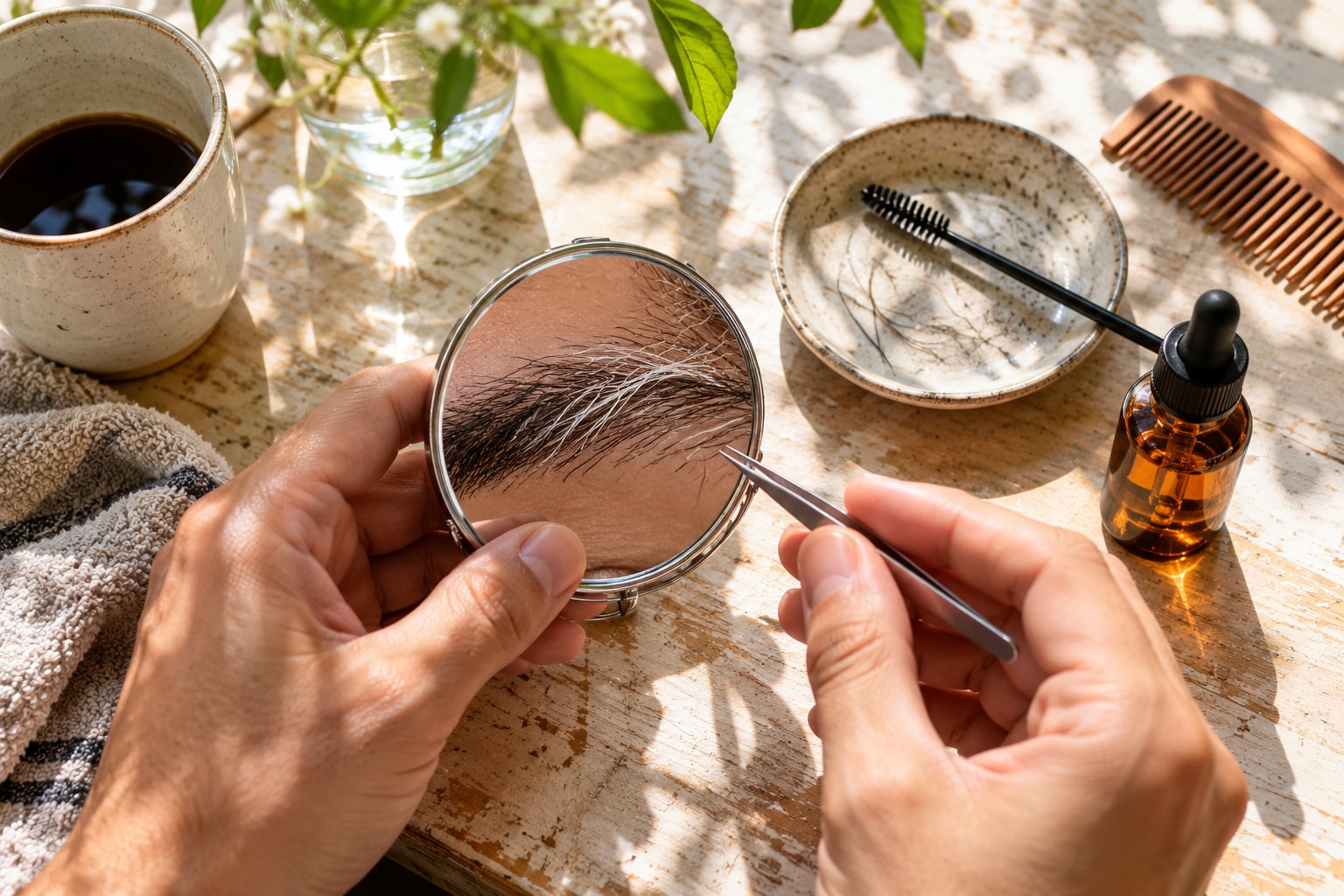
- Hair shape: One brow may have a higher arch, longer hairs, a sparse patch, or signs of past overplucking. The skin beneath both brows can still sit at the same height.
- Brow position: The whole hair-bearing brow sits higher, even when your forehead is relaxed. Bone and soft-tissue structure may account for part of the gap.
- Eyelid position: One upper eyelid sits lower, while the brow above it rises. Your forehead may be helping that eye look or feel more open.
Use one fair photo before drawing conclusions. Remove brow makeup, brush both brows in their usual direction, and place the camera straight ahead at eye height. Look forward with your mouth closed and let your forehead relax. Use the same light and distance if you repeat the check.
Take a second photo while raising both eyebrows normally. If the difference grows only with movement, muscle action is probably part of what you see. If only the hair outlines differ, grooming is the more useful target.
This setup matters. A clinical photography review by Nair and Santhanam found that small changes in angle, lighting, and position can alter facial comparisons. One tilted selfie is poor evidence of a fixed asymmetry.
Why one brow can sit higher
Natural facial asymmetry
The two sides of a face do not start as exact mirror copies. Small differences in the brow ridge, forehead tissue, hair pattern, and eyelid area can change the apparent height.
Perumal and Meyer reviewed 133 people who sought a blepharoplasty assessment. They found brow asymmetry in 88% of that group. That number does not describe the general public because every participant was already seeking an eyelid consultation. It does show why clinicians record asymmetry before treating the area.
A gap that appears in older photos and has stayed stable is usually less concerning than a new change. It also does not mean that one side of your face needs “correcting.”
Unequal forehead movement
The frontalis is the muscle that lifts your brows. It does not always move the skin in the same way on both sides.
Kwon and colleagues used three-dimensional photos on 30 healthy adults. During a maximal brow raise, 26 showed unequal skin movement between the two sides. The study was small, used an Asian adult sample, and tested a forced expression. It cannot tell us how often a resting brow difference occurs in everyone.
The useful point is narrower. A brow gap that changes with expression may be dynamic, rather than a fixed bone or hair difference. The study did not test facial exercises, so it gives no reason to expect “eyebrow workouts” to level your brows.
An eyelid that recruits the brow
A higher brow can be compensation. If an upper eyelid sits lower, the forehead may contract to help lift the tissue above that eye. The medical term for a low brow is brow ptosis. A low upper eyelid has a different cause and needs a proper eye assessment.
Do not assume the higher side marks your “dominant eye.” A 2018 study of 68 people with eyelid ptosis found no consistent match between eye dominance and the higher brow. It also found no consistent match between the lower eyelid and higher brow in that selected group.
In other words, the pattern can offer a clue, but it cannot diagnose the cause from a selfie.
Age, injury, or a previous procedure
Brow position can change as forehead tissue ages. Facial nerve injury, trauma, and operations near the brow can also lower one side. Botulinum toxin can cause brow droop when it weakens the wrong part of the lifting system.
If the difference began after an injection or procedure, contact the treating clinician. Do not try to offset it with more treatment from an unqualified provider.
Safe ways to make the brows look more balanced
Start with the reversible option that matches the cause you can see.
- For a hair-shape difference, let overplucked areas grow before taking more hair away. Brush each brow into place and use a fine pencil to add a few hair-like strokes where needed.
- For a higher hair arch, soften its top edge with makeup instead of repeatedly thinning both brows. Chasing perfect twins with tweezers often creates two smaller, still-different brows.
- For a stable position difference, a qualified brow professional can map a shape around your natural brow height. Ask for a conservative plan and keep enough hair to change course.
- For a lower eyelid, blocked upper vision, or a brow that feels tiring to hold up, book an eye examination. An ophthalmologist or oculoplastic specialist can separate eyelid ptosis from brow ptosis.
Botulinum toxin may alter a dynamic brow position, but it is not a home fix. Forehead movement varies by person, and misplaced treatment can lower the brow further. A licensed medical professional should assess both eyelids and brows at rest and during movement.
Skip face pulling, forceful massage, tape worn to reshape the brow, and one-sided “muscle training.” The studies above measure anatomy and movement. They do not show that these hacks create a safe, lasting correction.
When a higher eyebrow needs prompt care
A lifelong or slowly changing difference is not the same as sudden facial droop.
Call emergency services if one side of the face suddenly droops and you also have arm weakness or trouble speaking. The NHS lists that pattern as a possible stroke.
Get urgent medical advice for new one-sided facial weakness, a drooping eyelid or mouth, or trouble closing one eye. Bell’s palsy is one possible cause, and early assessment matters. Seek an eye examination for a gradual eyelid change that blocks vision or keeps getting worse.
FAQ
Does one higher eyebrow mean I have eyelid ptosis?
No. Eyelid ptosis can trigger compensatory brow lifting, but normal structure and unequal muscle movement can produce the same look. An eye professional checks the eyelid margin, brow position, forehead use, vision, and change over time.
Can eyebrow exercises make both brows level?
There is no support for that claim in the movement studies cited here. They show that forehead movement varies, not that training one side safely resets resting brow height. Repeated forced expressions may also make the difference more visible while you perform them.
Can sleeping on one side raise one eyebrow?
The sources reviewed here do not show that side-sleeping produces a lasting brow-height change. Do not sacrifice comfortable sleep to fix a cosmetic theory that has not been tested.
Can a professional use botulinum toxin for uneven brows?
A licensed clinician may use it for some movement-related differences after checking the eyelids and forehead. Results are temporary, and poor placement can cause brow droop. Do not buy injectable products or attempt treatment yourself.