Quick answer
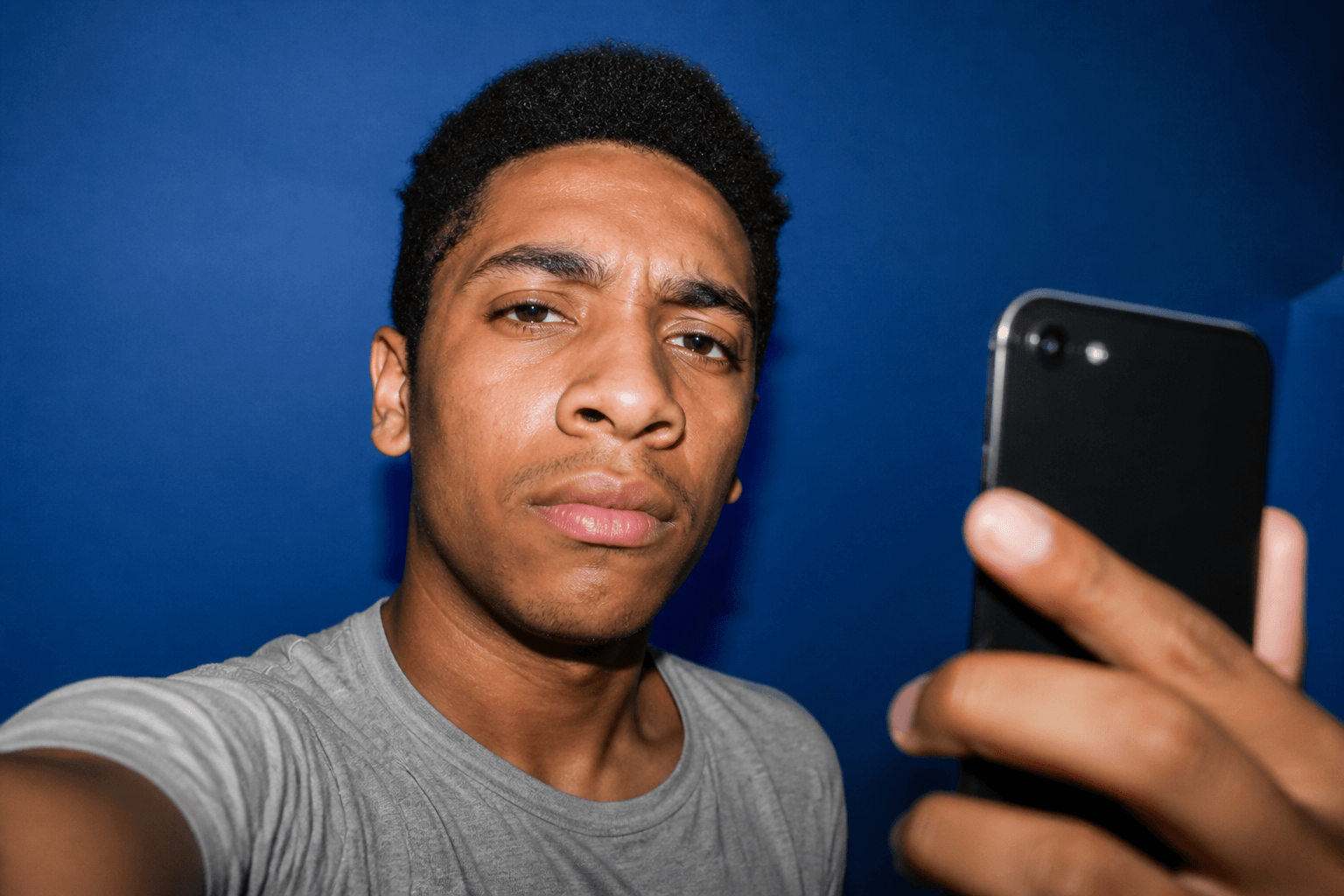
Why does my nose look bigger in selfies? Close camera distance changes perspective, making the nose look larger relative to the cheeks and ears. Your nose has not changed, and the photo is not a neutral measurement of its size. A photo taken from farther away usually gives a less exaggerated view.
Why close selfies enlarge the centre of your face
A camera turns a three-dimensional face into a flat image. Each facial feature sits at a slightly different distance from the lens.
Your nose projects farther forward than your cheeks and ears. At arm's length, those few centimetres form a meaningful share of the camera-to-face distance. The nearest feature then takes up more of the image than features behind it.
Move the phone back, and that depth difference becomes small beside the full distance. The relative proportions look less stretched.
This effect is called perspective distortion. People often blame a wide front-camera lens, but distance drives the change in facial proportions. A wide lens encourages close framing because your whole face fits on screen. The same close distance can distort a photo from a full-size camera.
What selfie studies actually found
The evidence comes from mathematical modelling and small photography studies. It shows a consistent direction of change. It does not give one correction number for every face or phone.
The 2018 nose model
Ward and colleagues modelled how camera distance changes apparent nose width. They used average adult head measurements rather than photographing a group of volunteers.
At 12 inches, the model made nasal width appear about 30% larger in men and 29% larger in women. Those figures describe nose width relative to face width. They do not mean every part of a real nose grows by 30% on screen.
At five feet, the model found almost no change from the real-world ratio. The large headline number is useful, but it remains an estimate based on average facial dimensions.
The 2022 phone study
Pressler and colleagues photographed 30 adults from 12 inches, 18 inches, and five feet. The close images used one front-facing phone camera. The five-foot images used a clinical camera under the same lighting.
Compared with the five-foot portraits, noses looked 6.4% longer at 12 inches and 4.3% longer at 18 inches. The 12-inch photos also shortened the apparent chin, which increased the nose-to-chin ratio.
This result is not the same as the 30% model estimate. The studies measured different dimensions with different methods. Both still show that moving closer exaggerates the central face.
The human study was small, with 23 women and seven men. It also tested one phone. Treat its averages as evidence of the effect, not a calculator for your own nose.
A newer camera comparison
A 2024 study photographed 12 people with a smartphone and a full-frame camera. Researchers tested several distances and lens settings.
The smartphone produced 18% more vertical midface distortion at eight inches and 12% more at 12 inches. Both comparisons used a full-frame photo from 60 inches as the reference. The full-frame camera also distorted faces when placed close.
That matters. Buying a different phone won't solve the basic geometry if you keep shooting from the same short distance.
Run a fair two-photo check
You can see the distance effect without rating your face or chasing a perfect angle. Take both photos in one session, with filters and face reshaping switched off.
- Take your usual arm's-length selfie with a neutral expression.
- Prop the phone four to five feet away and set a timer.
- Keep the camera at eye level, with your face centred and your head straight.
- Use the same light, background, camera, and expression for both photos.
- Crop the distant image afterward so both faces fill a similar area.
Compare the nose against stable landmarks, such as face width and chin length. Do not compare one close smile with one distant neutral face. Expression and head angle create a second set of changes.
If the nose looks smaller in the distant photo, you have measured perspective, not an overnight facial change. Four to five feet is not a perfect version of reality. It simply removes much of the close-range exaggeration.
Clinical photography uses the same principle. A published standard recommends keeping the camera between four and ten feet from the face. It also keeps distance, lighting, head position, and expression consistent between sessions.
Which camera setup gives a fairer view?
Distance matters more than choosing the front or back camera. At the same position, both cameras share the same perspective. Their sharpness, processing, and colour can still differ.
The back camera can help when you prop the phone farther away. It is not automatically more truthful. A back-camera photo taken eight inches from your nose still has close-range distortion.
Zoom also needs context. Cropping or zooming changes how much of the frame your face fills. It does not repair perspective while the camera remains close. Move the phone first, then adjust framing.
Keep the lens near eye level for a neutral front view. A high camera points down the nose, while a low camera reveals more nostril and underside. Those views may be intentional, but they are poor measurements.
Use consistent photos for appearance tracking
One flattering portrait and one harsh selfie cannot show progress. Choose a repeatable setup and compare like with like.
Mark where you stand and where the phone sits. Use similar daylight, a relaxed face, and the same camera setting each time. Pick a fixed interval, such as monthly, instead of checking several times each day.
LooksMax Scan tracks visible skin signals such as acne, pores, redness, oiliness, and dark circles. It does not measure true nasal anatomy or diagnose a condition. Its private scan uses the uploaded image for analysis rather than advertising or data resale.
For that scan, use a clear, well-lit, front-facing image. The same photo can support skin tracking, but it should not become a verdict on your facial proportions.
What not to conclude from one selfie
A large-looking nose in one close photo does not show that your nose is unusually large. It also does not establish a need for cosmetic treatment.
Real faces are seen in depth, in motion, and from changing distances. A selfie freezes one angle and one fraction of a second. Standardised photos are better for comparison, but no single image replaces an in-person view.
Do not use face filters as a diagnostic test. They change the target while hiding how much they changed. Pinching, pressing, or manipulating your nose cannot change the camera's position.
If you are considering any procedure, bring neutral photos and discuss them with a qualified clinician. A responsible assessment should include your goals, nasal function, anatomy, and an in-person examination.
When photo checking starts to take over
Concern about one feature can become more harmful than the feature itself. The NHS lists repeated mirror checking, constant comparison, hiding perceived flaws, and major daily distress among signs of body dysmorphic disorder.
You do not need a label before asking for help. Speak with a GP or mental health professional if photo checking consumes your time or makes you avoid people. That is a health concern, not vanity.
FAQ
Does the front camera make your nose look bigger?
It can, mainly because you hold it close to your face. The nose sits nearer to the camera than the cheeks and ears, so close perspective enlarges it relative to them.
How far should the camera be from your face?
Start around four to five feet away for a neutral comparison, then crop the image. Clinical photography guidance uses roughly four to ten feet and keeps the chosen distance consistent.
Does portrait mode remove selfie distortion?
No. Portrait mode can change blur, framing, or image processing, but perspective still depends on camera position. Moving the phone farther away is the useful change.
Is a selfie accurate enough to judge nose shape?
Not by itself. Use several unfiltered photos taken from a sensible distance, plus an in-person view. Never make a medical or cosmetic decision from one arm's-length selfie.