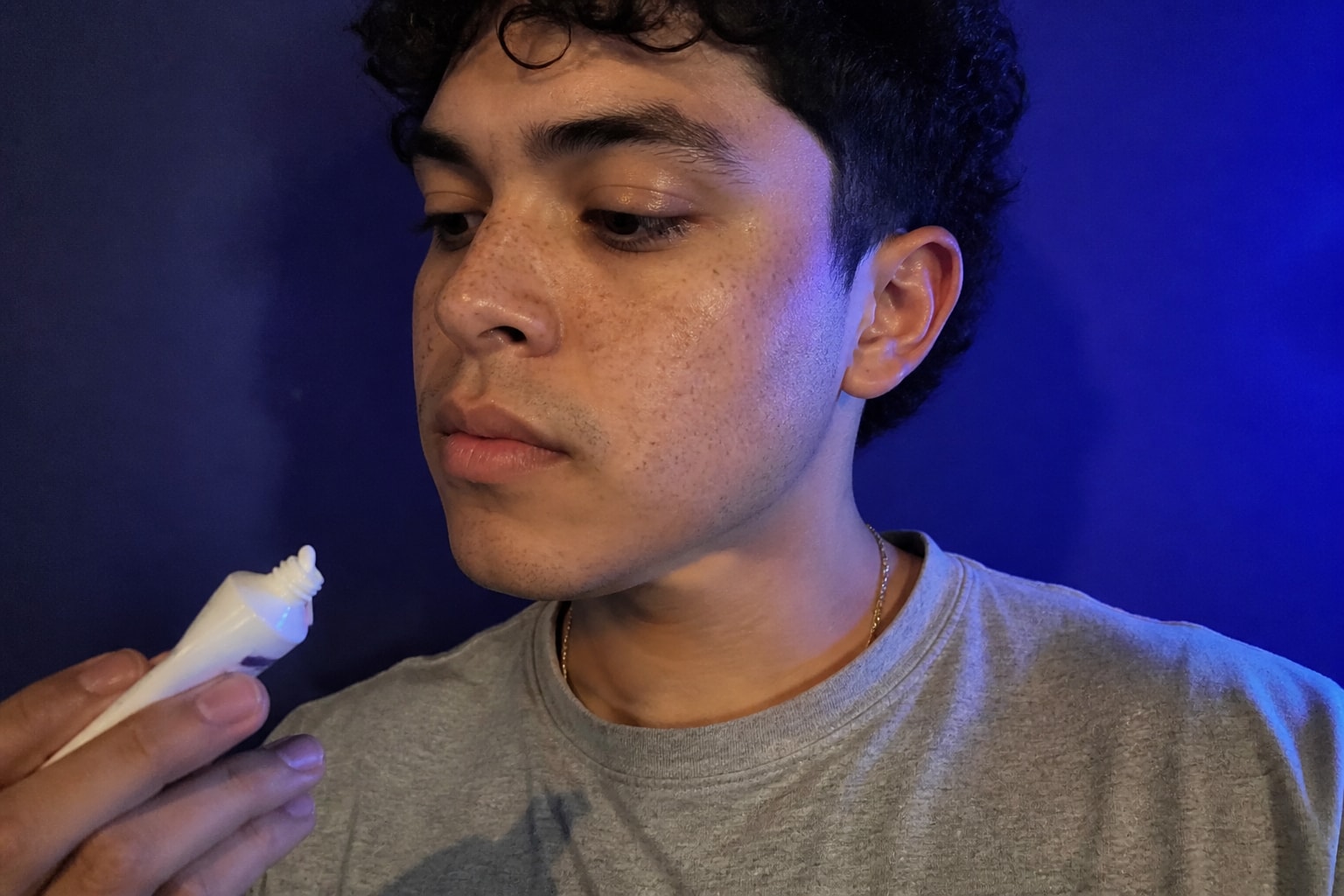
Quick answer
Does tretinoin cause facial fat loss? Current human evidence does not show that prescribed topical tretinoin shrinks facial fat pads. Trials and official safety information report irritation, dryness, redness and peeling, but not lipoatrophy.
That answer has a limit. The trials assessed skin and wrinkles, not facial fat volume with ultrasound or MRI. The fair conclusion is “not demonstrated,” rather than “proved impossible.”
What the human evidence actually measured
A 2025 meta-analysis combined eight randomized trials with 1,361 adults. Follow-up ranged from 16 weeks to two years. Tretinoin improved fine and coarse wrinkles, but caused more adverse events than the base creams.
Those events were mainly dryness, redness, peeling, burning and stinging. Facial fat loss was not a measured outcome. The review also did not identify it as a reported adverse effect.
The longest trial gives useful context. Researchers assigned 204 people with facial sun damage to 0.05% tretinoin cream or a vehicle cream for up to two years. They assessed appearance and took skin samples. Tretinoin improved several signs of sun damage and increased a marker of procollagen production. The researchers found no harmful microscopic change in the treated skin.
Again, this was not a fat-pad study. It cannot exclude a rare effect that it never set out to measure.
The current US DailyMed label points in the same direction. Its clinical-trial and post-marketing sections list local irritation, burning, redness, peeling, dryness, itching, dermatitis and pigment changes. They do not list facial lipoatrophy. A missing label entry is not proof of zero risk, but it means facial fat loss is not an established adverse reaction.
Minimal absorption is useful, but not the whole answer
A small human study measured how much tretinoin entered the body after cream was applied to the skin. Absorption was about 2% after one application and after 28 days. It averaged 1.1% in people treated for more than a year. Their average blood levels of tretinoin and its metabolites did not rise above their own baseline levels.
That makes a broad, whole-body fat-loss effect less plausible. It does not settle the local question, because the study did not image cheek or under-eye fat.
Online arguments often jump from cell experiments to a claim about a human face. A result in isolated cells at a chosen concentration does not tell you how much topical medicine reaches living facial fat. It also does not show a visible change in a person. Human outcome data carry more weight here. The clinical data reviewed above have not shown facial fat loss.
Why your face may look more hollow after starting tretinoin
The first suspect should be the skin surface. Tretinoin commonly causes dryness, scale, redness and irritation, especially early in treatment. Fine lines can look sharper when the surface is dry. Red or flaky skin also reflects light differently, which can deepen nearby shadows in a photo.
Photography adds more noise. Camera distance and focal length can alter facial proportions. Light, head angle and expression can also change the shadows you see. None of these proves that a fat pad changed.
Timing alone is weak evidence. Starting tretinoin before noticing a hollow does not show that tretinoin caused it. You need a repeatable change under matched conditions and a clinician’s assessment before calling it lipoatrophy.
Do not mix topical tretinoin with oral isotretinoin when reading anecdotes. They are different treatments with different exposure and safety profiles. Posts also tend to group tretinoin, retinol, retinal and other retinoids together, which makes the claim harder to evaluate.
Check the change without daily mirror testing
Start with two questions: is your skin irritated, and is the contour change still visible in fair conditions? Burning, marked redness, peeling, swelling or blistering fits the known irritation profile. Contact your prescriber rather than changing a prescription from forum advice.
For appearance tracking, use one repeatable setup:
- Use the same phone, lens, camera distance and head position.
- Stand in soft front light at the same time of day.
- Keep your face relaxed and remove contour makeup.
- Record body weight and any active irritation with the photo.
- Compare monthly, not several times a day.
A private photo or AI scan can help you log visible redness and texture. It cannot see through skin or diagnose loss of subcutaneous fat. Treat its output as a record of surface appearance, not a medical measurement.
If the hollow only appears under one light or lens, you have found a photo effect. If it persists across matched photos while your weight stays stable, show the sequence to the clinician who prescribed the tretinoin. A dermatologist can examine the skin, review the timing and decide whether another cause needs checking.
What not to do
Do not apply extra tretinoin to try to reduce cheek fat or sharpen your face. There is no clinical evidence that it works. The DailyMed label says using more than directed will not improve acne faster and may cause marked redness, peeling or discomfort.
Do not move it closer to your eyes to test the claim. Follow the product label and your prescriber’s directions. The eye area is easy to irritate, and a darker shadow after irritation can look like a deeper hollow.
Avoid using an unverified mail-order prescription or copying someone else’s strength. If your skin is reacting, ask your prescriber about the formula and the rest of your routine. Strong cleansers and other drying acne products can add to irritation.
FAQ
Can tretinoin thin your skin?
Tretinoin can make the surface peel and feel fragile during irritation, but that is not the same as losing facial tissue. In the two-year trial, researchers found no harmful microscopic change and recorded an increase in a marker of procollagen production.
Why do my under-eyes look more hollow after tretinoin?
Dryness, irritation and lighting can make under-eye shadows look deeper. Current trials do not show that topical tretinoin removes the under-eye fat pad. Keep the medicine away from the eyes as directed, and ask your prescriber to review a persistent change.
Will facial volume return after stopping tretinoin?
There are no clinical trials on recovery from alleged tretinoin-related facial fat loss because that effect has not been established. If the change comes from dryness or irritation, its appearance may ease as the skin settles. Ask the prescriber before changing treatment.
Can I use tretinoin to lose face fat?
No. Tretinoin is not a face-fat treatment, and extra product raises the chance of irritation. If facial fullness concerns you, do not use prescription skin medicine as a DIY fat-reduction method.