Quick answer
Canthal tilt is the slope between the inner and outer corners of your eye. Your adult tilt comes mostly from eyelid anatomy and its attachments, so exercises can't be expected to move it permanently. Head position, expression, brow grooming, and photo setup can still change how your eyes look.
“Hunter eyes” is internet slang, not a medical eye shape or a measure of your worth. Surgery can reposition the outer corner, but that means accepting real eye-area risks for a cosmetic change.
What is canthal tilt?
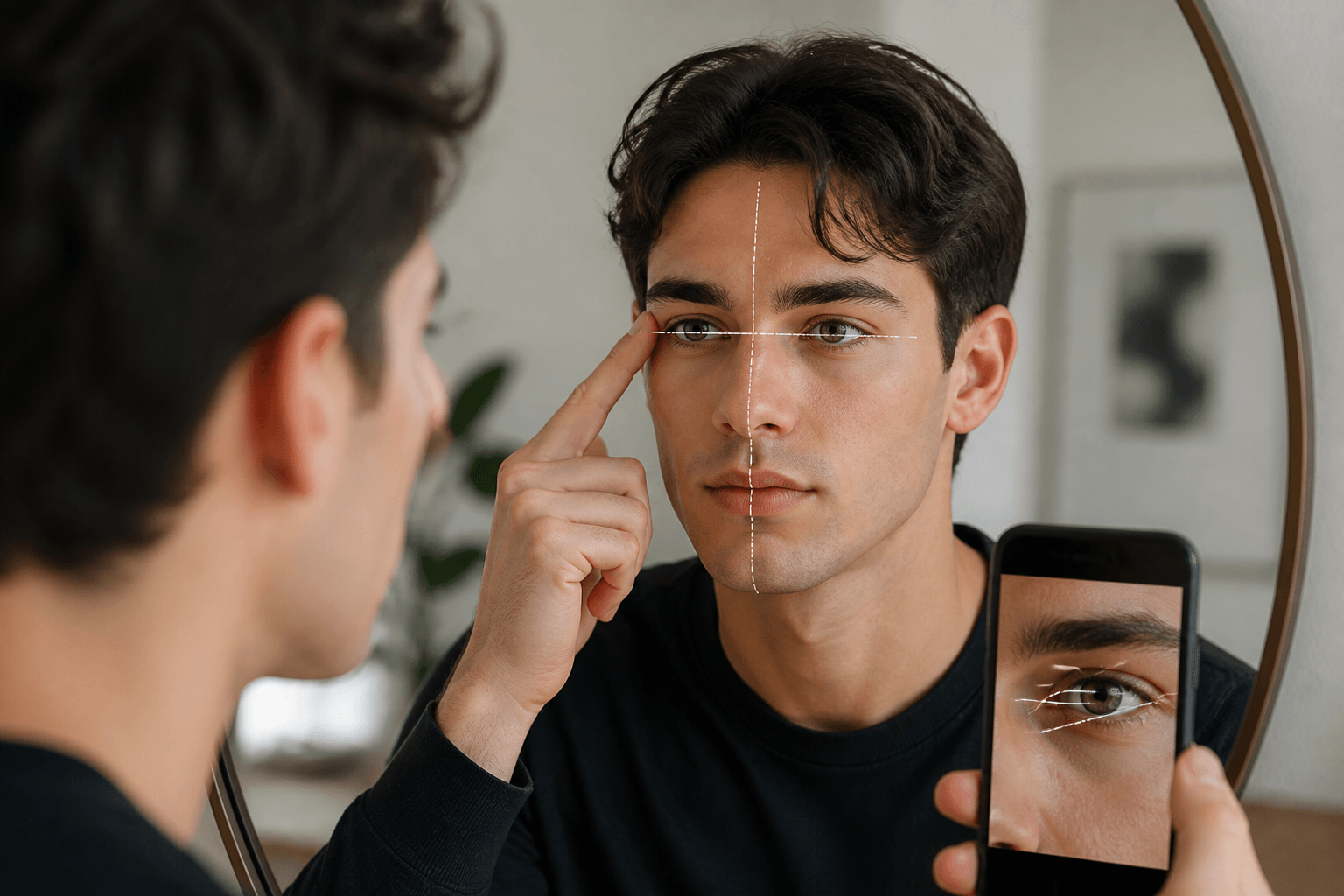
The medial canthus is the inner corner beside your nose, while the lateral canthus sits closer to your temple. Canthal tilt describes the line between those two points when your face is upright.
- A positive canthal tilt means the outer corner sits higher than the inner corner.
- A neutral canthal tilt means the corners look roughly level.
- A negative canthal tilt means the outer corner sits lower.
Those labels describe direction, not grades, diagnoses, or rankings.
StatPearls describes the lateral canthal tendon as a firm attachment near the outer rim of the eye socket. Muscle, a tarsal plate, connective tissue, and skin help set the lid's resting position and protect the eye.
That anatomy matters because a line drawn on a selfie makes canthal tilt look simple. The eye area isn't one movable angle because brow position, lid height, visible white, and eye-socket depth affect the picture.
What do people mean by “hunter eyes”?
Online guides usually use “hunter eyes” for eyes that look narrow, deep-set, and slightly upturned. They may also mention a low-looking brow and limited upper-lid show. There is no accepted medical checklist for the term.
Two canthal tilt filters may rate the same face differently because creators choose their own landmarks, reference lines, and cutoffs. A filter may also confuse a tilted head with tilted eyes.
The phrase “hunter eyes vs prey eyes” adds a false personality story to normal anatomy. Eye shape can't reveal someone's personality, confidence, or social value. Calling one common variation a failure turns a loose visual label into a harsh ranking system.
Use the neutral term canthal tilt, which names one visible feature without pretending it explains the whole face.
Does a positive canthal tilt make you more attractive?
No study establishes one tilt as a universal target because the best available work is much narrower than social posts imply.
Sforza and colleagues compared 199 young Italian adults with 126 people selected at beauty competitions. The competition group had greater eye-fissure inclination, but that association doesn't show the angle made anyone attractive.
The sample came from one country and a narrow age range, while beauty competitions use a specific selection process. The study can't tell you what every culture, age group, or individual prefers.
Canthal tilt attractiveness is therefore a poor reason to inspect your face by the degree. People see an entire face in motion. Expression, eye contact, grooming, and the relationship between features arrive together.
There is no losing category here.
Why does canthal tilt change in selfies?
Your anatomy may stay fixed while head pitch shifts the apparent line between the eye corners in a two-dimensional image.
Vaca and colleagues analyzed 24 eyes from 12 women, using head positions from 15 degrees downward to 15 degrees upward. They kept the camera at eye level. Across that range, the vertical gap between inner and outer corners changed from about 0.13 mm to 4.39 mm.
The study included only 12 women aged 22 to 36, so it can't define the most flattering pose for everyone. It does show why a casual canthal tilt test can mistake camera setup for anatomy.
For a fair check, use this repeatable setup.
- Put the camera at eye level and face it straight on.
- Keep your head upright rather than tipping your chin up or down.
- Use the same distance, lens setting, light, and neutral expression each time.
- Look toward the lens without squinting or raising your brows.
- Compare several photos instead of choosing the harshest frame.
This protocol is useful for tracking, not scoring, and a canthal tilt filter can still place its dots poorly. Check whether it marks the real inner and outer corners before trusting the line.
Can canthal tilt exercises create hunter eyes?
There is no good clinical evidence that canthal tilt exercises permanently reposition the eye corners. Squinting contracts muscle for a moment. It doesn't prove that the canthal tendon has moved on the orbital rim.
A 2014 systematic review by Van Borsel and colleagues searched for evidence on facial exercises and facial rejuvenation. The team found nine reports and judged the evidence insufficient. None established a routine that moves adult canthal attachments into a new resting position.
That review didn't test every “hunter eye exercise” now posted online, and it can't prove that every future method will fail. Confident before-and-after claims are still running ahead of clinical evidence.
The same limit applies to eye yoga, repeated squinting, massage, and mewing for hunter eyes. A pose can briefly narrow the visible eye opening without creating a permanent change in canthal tilt.
Don't pull, press, or repeatedly force the skin around your eyes to chase an angle. Eye comfort and normal blinking matter more than a social-media label. Stop any habit that causes pain, dryness, redness, or visual symptoms, and speak with an eye-care professional.
What can you safely change without surgery?
You can improve the framing of your eyes through changes that are reversible and easy to judge in normal life.
Keep your expression relaxed
A forced squint may copy one edited reference photo, but it often looks strained in conversation. Relax your forehead, open your eyes normally, and let your gaze move. This also gives you a more honest progress photo.
Groom the frame, not the eyeball
Tidy obvious stray brow hairs while keeping your natural brow line. Haircuts and glasses can also change how the upper face is framed. Make one small change, then view it from normal speaking distance.
Fix the comparison method
Delete the folder of ten nearly identical selfies. Keep one neutral photo from the same setup each month. This reduces noise from head pitch, expression, and daily appearance changes.
Treat health changes as health changes
A new eyelid droop, trouble closing an eye, pain, or a vision change isn't a looksmaxxing problem. Arrange an assessment with an optometrist, ophthalmologist, or doctor. Don't try to correct a sudden change with exercises.
These steps won't create a new orbital structure. They can make your presentation look more deliberate without turning your eyes into a project.
Can surgery change canthal tilt?
Yes, surgery can change the position or support of the eye corner. Cleveland Clinic describes canthoplasty as an operation that reconstructs and lifts the canthus. It can involve tightening muscles, tendons, ligaments, and connective tissue.
Canthopexy is related but usually reinforces the outer corner without cutting the existing tendon or muscle. The right procedure depends on eyelid support, eye health, anatomy, and the intended change. A qualified oculoplastic surgeon must assess those factors in person.
Canthoplasty risks include scarring, bleeding, swelling, pain, dry eyes, infection, and difficulty closing the eyes. Cleveland Clinic gives a typical full recovery range of two to four weeks. Permanent results can still change as the face ages.
That tradeoff is different from trying a haircut or brow tidy. Don't book eye surgery from a filtered mock-up or an online “ideal angle.” If you are considering it, ask what functional change is planned and how the surgeon will protect lid closure.
Ask to see standardized before-and-after photos with matching head position. The Vaca study shows why this detail matters. A dramatic change can come from pitch even when the eyelid itself hasn't changed.
When does measuring stop being useful?
Tracking should help you make calm decisions, but it stops helping when you check many times daily or avoid people because of it.
The NHS lists repeated mirror checking, comparison, and prolonged worry about a facial feature among possible signs of body dysmorphic disorder. Ordinary grooming interest doesn't mean you have BDD; distress and disruption are the concern.
If appearance checking is taking over your day, pause the filters and speak with a GP or mental-health professional. Seeking practical care isn't failure.
FAQ
What is a positive canthal tilt?
A positive canthal tilt means the outer eye corner sits higher than the inner corner when your head is upright. It is a normal anatomical description, not an attractiveness score.
Can you change a negative canthal tilt naturally?
No reliable evidence shows that exercises, massage, squinting, or mewing can permanently move adult canthal attachments. Photos and grooming can change the appearance, while structural repositioning is surgical.
Do hunter eye exercises work?
Hunter eye exercises may change your expression while you perform them, but clinical evidence doesn't show a lasting canthal tilt change. Before-and-after photos need matched head position and lighting.
Is canthal tilt genetic?
Your resting eye shape develops from anatomy that includes the eyelids, tendons, muscles, soft tissue, and eye socket. Families may share features, but no simple canthal-tilt gene determines attractiveness.
Can canthoplasty give you hunter eyes?
Canthoplasty can reposition or support an eye corner, so it may change canthal tilt. It is permanent surgery with risks, and only a qualified oculoplastic surgeon can judge suitability.